|
 |
 |
 |
 |
 |
 |
 |
 |

 |
Russia's Energomash To Double Production Of Rocket Engines
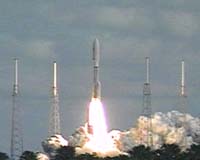
Khimki, Russia (RIA Novosti) May 07, 2008 Russia's Energomash is planning to double the number of engines produced for Atlas and Zenit launch vehicles in the future, the head of the company said on Tuesday. Energomash won tenders on the design and production of 101 RD-180 engines for U.S. Atlas carrier rockets and RD-171 engines for Russian-Ukrainian Zenit rockets in the 1990s. The company has built and delivered 41 RD-180 and 20 RD-171 engines so far. "At present, we manufacture five RD-180 engines per year and we are planning to increase annual production to 8-10 in the near future," said Nikolai Pirogov, Energomash general director. "In addition, we build 5-6 RD-171 engines per year and are also planning to raise this number to 10," he said. Pirogov also said the company would finish testing an RD-191 engine for Russia's new Angara carrier rocket by the end of 2008. "We are two-thirds of the way through," he said. "If we get sufficient financing, we will finish the work on the engine this year." The Angara family of carrier rockets, designed by the Khrunichev center, will compliment, and eventually replace, the existing line of Rockot and Proton launch vehicles. The new rocket can deliver a payload of up to 24.5 tons to a 200-km (124 miles) orbit. Energomash conducts about 50 tests of new engines annually. The company, founded in 1929, built engines used on the R-7 rocket, which sent the first Sputnik into space, as well as for Proton and Energia rockets among numerous other engines.
Source: RIA Novosti Community Email This Article Comment On This Article Related Links Rocket Science News at Space-Travel.Com
 Queensland Uni And NASA Sign Hypersonic Propulsion Deal
 Brisbane, Australia (SPX) Apr 28, 2008
The University of Queensland has signed a memorandum of understanding with NASA to continue close collaboration on hypersonic propulsion projects. Hypersonics is the study of velocities of Mach 5 (five times the speed of sound) or more. The University of Queensland's Centre for Hypersonics, one of the largest space engineering University groups in the world, conducts research into all aspects of hypersonic flight. |
|
|

| The content herein, unless otherwise known to be public domain, are Copyright 1995-2007 - SpaceDaily.AFP and UPI Wire Stories are copyright Agence France-Presse and United Press International. ESA Portal Reports are copyright European Space Agency. All NASA sourced material is public domain. Additional copyrights may apply in whole or part to other bona fide parties. Advertising does not imply endorsement,agreement or approval of any opinions, statements or information provided by SpaceDaily on any Web page published or hosted by SpaceDaily. Privacy Statement |