
 |
 |
 |
 |
 |
 |
 |
 |
 |

 |
Russia, Cuba To Implement Joint Space Programs
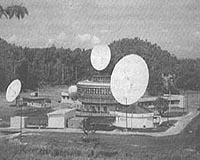
Moscow (RIA Novosti) Sep 23, 2008 There is every reason to say that Russia has started reasserting its global position. This includes big-time politics and efforts to expand scientific and military-technical cooperation with other countries, including Cuba, the Soviet Union's main Latin American ally. It is hard to overestimate the importance of Latin America, and Cuba in particular, for Russia. Commenting on the results of Security Council Secretary Nikolai Patrushev's August 2008 visit to Cuba, Andrei Klimov, deputy chairman of the foreign affairs committee of the State Duma, said Russia, as a major power, needed to maintain its economic and security presence in Cuba. In mid-September, Moscow and Havana negotiated joint space projects. Anatoly Perminov, director of the Federal Space Agency (Roscosmos), said the sides had discussed the possibility of setting up a Cuban space center with Russian assistance. Perminov said both countries had discussed the implementation of agreements reached by the Russian-Cuban inter-governmental commission two months ago. "This primarily concerns the drafting of a cooperation agreement on civilian space programs, another agreement on the Global Navigation Satellite System and navigation support on Cuban territory," Perminov said. The proposed Cuban space center will process data received from Russian remote-sensing and navigation satellites. We also plan to jointly use orbital telecommunications networks, Perminov said. Cuba, which at one time implemented an ambitious space program, retains the required infrastructure for resuming large-scale space research. Several dozen Cuban agencies, including the R and D Institute of Geophysics and Astronomy, the Institute of Meteorology and the Fundamental Technical Research Institute of the Cuban Academy of Sciences, were involved in the national space program. In the mid-1960s, Moscow and Havana launched a space-physics project, obtaining new data on the upper ionosphere with the help of Soviet satellites. A tracking station, built near Santiago de Cuba in 1967, made it possible to observe high-orbit Soviet scientific satellites. Cuba, an insular state, has to expand orbital telecommunications networks linking it with the rest of the world. In 1973, the Caribe space-communications station was completed 40 km from Havana, becoming part of the InterSputnik network that comprised the socialist bloc's telecommunications satellites. Soviet weather and remote-sensing satellites facilitated Cuban agricultural programs. Both countries also worked closely in manned space missions. Cuban specialists helped assess crew compatibility and the adaptation of cosmonauts to work-and-rest routines aboard orbital stations. In September 1980, Arnaldo Tamayo Mendez became the first Cuban cosmonaut and the first person from a country in the Western Hemisphere other than the United States to travel into Earth orbit, spending about eight days aboard the Soviet Salyut-6 station. The Cuban space-research experience, plus up-to-date Russian technical achievements, will help both countries implement advanced space programs. The opinions expressed in this article are the author's and do not necessarily represent those of RIA Novosti.
Source: RIA Novosti Community Email This Article Comment On This Article Share This Article With Planet Earth
Related Links Station and More at Roscosmos S.P. Korolev RSC Energia Russian Space News
 France to buy 10 Soyuz launchers from Russia
 Sochi, Russia (AFP) Sept 20, 2008
The European commercial space-launch consortium Arianespace on Saturday signed a deal with the Russian space agency Roskosmos to acquire 10 new Soyuz launchers for around 500 million dollars (347 million euros), a French diplomatic source told AFP. |
|
|

| The content herein, unless otherwise known to be public domain, are Copyright 1995-2007 - SpaceDaily.AFP and UPI Wire Stories are copyright Agence France-Presse and United Press International. ESA Portal Reports are copyright European Space Agency. All NASA sourced material is public domain. Additional copyrights may apply in whole or part to other bona fide parties. Advertising does not imply endorsement,agreement or approval of any opinions, statements or information provided by SpaceDaily on any Web page published or hosted by SpaceDaily. Privacy Statement |
 del.icio.us
 Digg
Digg Reddit
 YahooMyWeb
 Google
 Facebook