
 |
 |
 |
 |
 |
 |
 |
 |
 |

 |
Russia Conducts CIS Wide Integrated Air Defense Exercise
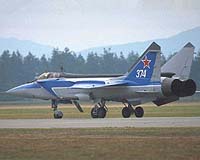
Washington (UPI) Oct 30, 2008 Russia continues to step up the alertness and combat readiness of its prime domestic anti-aircraft and ballistic missile defense systems in cooperation with its close allies. The Russian-dominated Commonwealth of Independent States last week announced the successful completion of a joint command-and-staff air defense exercise as part of the integrated air defense network, the RIA Novosti news agency reported Oct. 23. The report said that elements of the CIS integrated air defense network based in Kazakhstan, central Russia and Siberia, Belarus, Ukraine, Tajikistan and Uzbekistan all participated in the maneuvers. It described the CIS as "an alliance of former Soviet republics." "All the tasks, including testing combat interoperability of CIS air defense units, have been accomplished successfully," three-star Col. Gen. Alexander Zelin, the head of the Russian air force, announced. RIA Novosti noted that the CIS integrated air defense network was created on Feb. 10, 1995, to cover 10 CIS member nations. However, the former Soviet republic of Georgia in the Caucasus has recently pulled out of the integrated network since the Russian army occupied one-third of Georgia in a lightning five-day military operation from Aug. 8 to Aug. 12. According to the RIA Novosti report, the CIS air defense network currently consists of "seven air defense brigades, 46 units equipped with S-200 and S-300 air defense missile systems, 23 fighter units equipped with MiG-29, MiG-31 and Su-27 aircraft, 22 electronic support units and two detachments of electronic warfare." Zelin stated that the Russian air force planned to restructure its units into four air force and air defense commands in strategic regions as part of Defense Minister Anatoly Serdyukov and Chief of the General Staff Gen. Nikolai Makarov's ambitious military reform plans. "These commands will be formed in Russia's Far East, in Siberia, and in southern and northwestern Russia," the general stated. RIA Novosti noted that Serdyukov had previously stated he planned to slim down the number of units in the Russian air force from 340 to 180 as part of his restructuring.
U.S. Navy test-fires Raytheon Tomahawk Block IV. Raytheon said the successful test "completes the integration of the Tomahawk cruise missile onto the Navy's newest fast-attack submarine." "Integration of the Tomahawk Block IV on the Virginia-class submarine provides the fleet with a powerful combination of delivering Special Operations Forces and supporting them with the power and precision of the Tomahawk missile," said Capt. Rick McQueen, the U.S. Navy's program manager for the Tomahawk weapon system. "The Tomahawk currently is used very effectively in the global war on terror. The fleet now has the ability to expand the prosecution of this mission with increased stealth, flexibility and precision firepower," McQueen said. Raytheon described the Tomahawk Block IV as "a surface- and submarine-launched precision strike stand-off weapon" that was "designed for long-range precision strike missions against high-value and heavily defended targets." "This test highlights a successful integration effort that provides all the capabilities of the Tomahawk missile on Navy platforms that include destroyers, cruisers, fast-attack and guided-missile boats," said Gary Hagedon, Raytheon's Tomahawk program director. Raytheon said the firing marked the 16th consecutive test of the Tomahawk Block IV and that it fulfilled the U.S. Navy's 2008 test schedule of eight launches.
German Patriot fired with PAC-3 upgrade. Members of the German air force, or Luftwaffe, working with Lockheed Martin and the U.S. Army Lower Tier Project Office, carried out the test, which was the second of the upgraded system, Lockheed Martin said. "The test demonstrated the Patriot Configuration-3 upgrades to the German Patriot ground system, which includes the PAC-3 missile segment launcher electronics and the Fire Solution Computer that are necessary to launch PAC-3 missiles," the company said in a statement. "Today's successful flight test marks another significant milestone for both the Program Executive Office Missiles and Space and our allies," said Lt. Col. Anthony Brown, PAC-3 product manager. "We continue to build on the legacy of this superb weapon system as a key element for the free world's defense." "Our German partners have taken an important step in improving their air and missile defense capability with the Patriot PAC-3 system," said Mike Trotsky, vice president Air and Missile Defense Programs at Lockheed Martin Missiles and Fire Control. "We are very proud to support our German allies in this, the second international PAC-3 missile test." Community Email This Article Comment On This Article Share This Article With Planet Earth
Related Links Learn about missile defense at SpaceWar.com Learn about nuclear weapons doctrine and defense at SpaceWar.com All about missiles at SpaceWar.com Learn about the Superpowers of the 21st Century at SpaceWar.com
 US missile chief concerned by delays to Polish base accord
 Warsaw (AFP) Oct 30, 2008
A top US defence official Thursday said he was worried that delays in Poland's ratification could upset a tight timetable for deploying American missiles here to ward off attacks from so-called rogue states. |
|
|

| The content herein, unless otherwise known to be public domain, are Copyright 1995-2007 - SpaceDaily.AFP and UPI Wire Stories are copyright Agence France-Presse and United Press International. ESA Portal Reports are copyright European Space Agency. All NASA sourced material is public domain. Additional copyrights may apply in whole or part to other bona fide parties. Advertising does not imply endorsement,agreement or approval of any opinions, statements or information provided by SpaceDaily on any Web page published or hosted by SpaceDaily. Privacy Statement |
 del.icio.us
 Digg
Digg Reddit
 YahooMyWeb
 Google
 Facebook