|
 |
 |
 |
 |
 |
 |
 |
 |

 |
Runway Project Clears the Way for Improved Antarctic Airlift
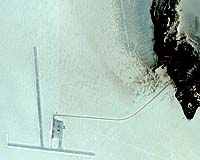
McMurdo Station - Feb 25, 2002 The U.S. Air Force has certified a newly constructed glacial ice runway near Antarctica's McMurdo Station as capable of handling large military cargo jets. The certification marks an important improvement in the U.S. Antarctic Program's (USAP) ability to support science research for the National Science Foundation on Earth's southernmost continent. A U.S. Air Force C-141 Starlifter cargo plane landed safely on the compacted snow pavement of the existing Pegasus runway near the USAP's logistical hub at McMurdo on Jan. 29 (local time). Among the aircraft's 103 passengers was Charles J. Swindells, the U.S. ambassador to New Zealand, on his way to visit USAP installations and field camps. (U.S. Stations in Antarctica keep New Zealand time.) Preparation of the runway pavement required the use of 100-ton pneumatic tire rollers to compact a thin snow cover, turning the snow into white ice, a material sturdy enough to handle four-engine military transport aircraft. The addition of this white ice pavement allows all-season landings of wheeled aircraft in the Antarctic for the first time in history. Currently, ski-equipped LC-130 Hercules cargo aircraft flown by the New York Air National Guard transport much of the cargo and many of the passengers to Antarctica. The new runway greatly enhances airlift capabilities to support USAP activities. The newly developed compaction process protects the runway from sun damage while having the structural strength necessary to withstand the stresses imposed by the landing of large aircraft such as the C-5 Galaxy, one of the world's largest aircraft; the C-17 Globemaster, the newest air force cargo plane; and the older C-141s. Without a cover of snow as protection, the warm temperatures and high sun angles during the height of the Antarctic summer would have damaged the runway. Prior to the U.S Air Force's certification of the Pegasus runway to handle the larger cargo aircraft, wheeled aircraft were able to land on the continent only very early and very late in the research season on runways that at other times of the year are useable only by ski-equipped planes. The principal austral summer research season begins in October and ends in February. The National Science Foundation operates the U.S. Antarctic Program, which coordinates almost all U.S. scientific activity on the continent. Community Email This Article Comment On This Article Related Links SpaceDaily Search SpaceDaily Subscribe To SpaceDaily Express Nuclear Space Technology at Space-Travel.com
 Rewriting Glacial History In Pacific North America
 Edmonton AB (SPX) Jan 10, 2006
Although the story on glacier fluctuations in northwestern North America over the last 10,000 years has remained largely unchanged for decades, new evidence discovered by a University of Alberta researcher will rewrite that glacial history and offer clues about our climate history during the last several thousand years. |
|
|

| The content herein, unless otherwise known to be public domain, are Copyright 1995-2006 - SpaceDaily.AFP and UPI Wire Stories are copyright Agence France-Presse and United Press International. ESA PortalReports are copyright European Space Agency. All NASA sourced material is public domain. Additionalcopyrights may apply in whole or part to other bona fide parties. Advertising does not imply endorsement,agreement or approval of any opinions, statements or information provided by SpaceDaily on any Web page published or hosted by SpaceDaily. Privacy Statement |