|
 |
 |
 |
 |
 |
 |
 |
 |

 |
Rovers Look Forward to A Second Martian Spring
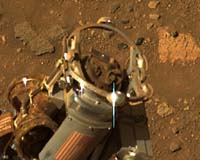
Pasadena CA (JPL) Aug 16, 2006 Like the fabled tortoise that, in the race with the hare, moves slowly yet accomplishes much, NASA's Mars Exploration Rover Spirit has continued to make progress little by little, while essentially running in place. Eking out a steady stream of scientific data as solar power levels have plunged to a seasonal low during the rover's second Martian mid-winter, Spirit has discovered meteorites that might otherwise have been missed and completed work on a 360-degree, full-color panorama of its surroundings. The rover has collected long-term observations of the Martian atmosphere, rocks, and soils under varying conditions of sunlight, temperature, and wind. "Spirit has conducted a regular routine of scientific observations," said Jake Matijevic, rover engineering team chief, "though they haven't been very extensive each day because the energy levels don't allow that. After the solstice, we'll turn the rover to investigate a different part of the surface. We'll move very carefully to preserve our tilt toward the sun." The winter solstice falls on Tuesday, Aug. 8, 2006, Spirit's 923rd sol, or Martian day, of exploration. Since April, the rover has been parked on an outcrop known as "Low Ridge Haven," tilted 11 degrees to the north.
Opportunity Continues Trek Opportunity recently arrived at another, smaller crater known as "Beagle Crater," which is 35 meters (115 feet) wide. Scientists plan to spend some time examining rocks that were excavated onto the surface during the impact that formed the crater. Opportunity is collecting full-color panoramic images of the site. Like Spirit, Opportunity will have more power for science operations as the days grow longer before and after the vernal equinox on Feb. 8, 2006, when the lengths of the day and night will be equal. On Earth, the vernal equinox is considered the official start of spring.
No Stranger to Adversity Using this maneuver, the rover dragged the ailing wheel behind the vehicle, carving a trench in the sand. Rover handlers are optimistic that Spirit will be able to explore all but the steepest or sandiest terrain. "I think we should be able to drive Spirit 10 to 15 meters (30 to 45 feet) a day when solar power is restored to optimum levels," observed Matijevic. "Sandy areas are going to have to be treated as obstacles. We'll be looking for routes that are not too rocky but that also do not have much sand."
Looking Ahead "When Spirit has sufficient energy, which may be early September, we're thinking about turning the rover about 30 degrees to get a better look at the bright soil churned up by the rover's right front wheel," Banerdt said. "We'll look at the chemical composition to see if it's made of sulfate salts like other deposits we've visited. We'll have excellent data from the 13-filter, panoramic camera images to guide us to promising targets for further study." The ascending sun will also bring warmer temperatures - warmer, that is, for Mars. The coldest day of the Martian year will probably be the same as the shortest day, said Matijevic. Unlike Earth, Mars does not have a thick atmosphere to buffer changes in temperature. Though Spirit is not awake to measure the coldest temperatures in the middle of the night, models estimate that Spirit's solar panels have recently experienced frigid temperatures of about -104 degrees C (-155 F.). Location, however, does make a difference. Being stationed on a heat-absorbing rock has probably kept the rover slightly warmer than it would have been out on the sands of the "Inner Basin," he added. Though surviving on Mars is always a challenge, there have been no surprises this winter. Energy levels and operating temperatures have been in agreement with what engineers predicted. "Our experiences this winter are very similar to what we experienced last winter," said Matijevic. Community Email This Article Comment On This Article Related Links Mars Rovers at JPL Mars Rovers at Cornell Mars News and Information at MarsDaily.com Lunar Dreams and more
 AMASEing Mars
 Svalbard Archipelago (SPX) Aug 15, 2006
High in the Arctic, just below Earth's north polar ice cap, a collaboration of nearly two dozen biologists, geologists, and engineers have embarked on an expedition to Mars. The scientists and researchers are spending two and a half weeks at the Svalbard archipelago in the Arctic Ocean north of Norway. |
|
|

| The content herein, unless otherwise known to be public domain, are Copyright 1995-2006 - SpaceDaily.AFP and UPI Wire Stories are copyright Agence France-Presse and United Press International. ESA PortalReports are copyright European Space Agency. All NASA sourced material is public domain. Additionalcopyrights may apply in whole or part to other bona fide parties. Advertising does not imply endorsement,agreement or approval of any opinions, statements or information provided by SpaceDaily on any Web page published or hosted by SpaceDaily. Privacy Statement |