|
 |
 |
 |
 |
 |
 |
 |
 |

 |
Rosetta: The Space Sophisticate Faces Long Journey Of Obscurity
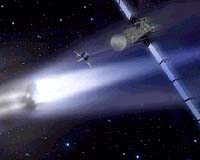
Paris - Feb 18, 2004 The European Space Agency's Rosetta mission will be getting under way in February 2004. The Rosetta spacecraft will be pairing up with Comet 67P/Churyumov-Gerasimenko and accompanying it on its journey, investigating the comet's composition and the dynamic processes at work as it flies sunwards. The spacecraft will even deposit a lander on the comet. "This will be our first direct contact with the surface of a comet," said Dr Manfred Warhaut, Operations Manager for the Rosetta mission at ESA's European Space Operations Centre (ESOC) in Darmstadt, Germany. The trip is certainly not short: Rosetta will need ten years just to reach the comet. This places extreme demands on its hardware; when the probe meets up with the comet, all instruments must be fully operational, especially since it will have been in "hibernation" for 2 and a half years of its journey. During this "big sleep", all systems, scientific instruments included, are turned off. Only the on-board computer remains active.
Twelve cubic metres of technical wizardry The lander is fixed to the opposite side of the probe from the steerable antenna. As the spacecraft orbits the comet, the scientific instruments will at all times be pointed towards its surface; the antenna and solar panels will point towards the Earth and Sun respectively. For trajectory and attitude control and for the major braking maneuvres, Rosetta is equipped with 24 thrusters each delivering 10 N. That corresponds to the force needed here on Earth to hold a bag containing 10 apples. Rosetta sets off with 1650 kg of propellant on board, accounting for more than half its mass at lift-off. Just 20% of total mass is available for scientific purposes. So when developing the research instruments the same rule applied as for supermodels: make every gram count. The calculation seems to have worked out right: the main probe will be carrying 11 scientific instruments and the Rosetta lander a further ten. They will analyse the composition and structure of the comet's nucleus and study its interaction with the solar wind and the interplanetary plasma.
Rosetta - unplugged These dimensions are also essential because when Rosetta meets Churyumov-Gerasimenko it will be 675 million kilometres away from the Sun. At that distance solar radiation is very weak and the solar collectors will supply only 440 W of power - compared with 8000 W towards the end of the mission when the two companions come closest to the Sun (at some 150 million kilometres from our star distance). "The probe is also equipped with a set of four 10-amp-hour batteries to maintain power supply while Rosetta flies in the shadow of the comet."
Rosetta lander - standing on its own three legs Thanks to a mechanical arm, the lander will operate in a two-metre radius. The soft landing is a particular problem given the extremely weak gravitational force exerted by the very small comet nucleus; the lander, weighing in at 100 kg on Earth, will on the comet be as light as a sheet of paper. If there were the slightest recoil, it would bounce back uncontrollably like a rubber ball. To make sure this doesn't happen, the lander's three legs are equipped with special shock-absorbers which take up most of the kinetic energy. The legs are also fitted with ice pitons; these bore into the ground immediately on touchdown. At the same moment, the lander fires a harpoon to anchor it to the ground - an opportunity also to investigate the mechanical properties of the surface. "If everything goes according to plan, the mission results could well fundamentally expand our knowledge of comets, just as the Rosetta Stone, after which the probe is named, helped unravel the mystery of Egyptian hieroglyphics," said Manfred Warhaut. Community Email This Article Comment On This Article Related Links Rosetta at ESA SpaceDaily Search SpaceDaily Subscribe To SpaceDaily Express Asteroid and Comet Mission News, Science and Technology
 Stardust Entry Path To Be Visible In Northwest
 Pasadena CA (JPL) Jan 10, 2006
On January 15, 2006, after more than 7 years and billions of miles of travel through space, NASA's Stardust spacecraft will release a 100-pound sample return capsule (SRC) to Earth with some precious cargo - pristine samples of comet and interstellar dust. |
|
|

| The content herein, unless otherwise known to be public domain, are Copyright 1995-2006 - SpaceDaily.AFP and UPI Wire Stories are copyright Agence France-Presse and United Press International. ESA PortalReports are copyright European Space Agency. All NASA sourced material is public domain. Additionalcopyrights may apply in whole or part to other bona fide parties. Advertising does not imply endorsement,agreement or approval of any opinions, statements or information provided by SpaceDaily on any Web page published or hosted by SpaceDaily. Privacy Statement |