
 |
 |
 |
 |
 |
 |
 |
 |
 |

 |
Rosetta Starts Tracking Asteroid Steins
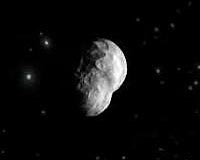
Paris, France (SPX) Aug 06, 2008 Heading toward its first target-asteroid, (2867) Steins, ESA's Rosetta spacecraft has started using its cameras to visually track the asteroid and eventually determine its orbit with more accuracy. Rosetta started the optical navigation campaign on 4 August 2008, at a distance of about 24 million km from Steins; the campaign will continue until 4 September, when the spacecraft will be approximately 950 000 km from the asteroid. "The orbit of Steins, with which Rosetta will rendezvous on 5 September, closing to a distance of 800 km, is only known thanks to ground observations, but not yet with the accuracy we would like for the close fly-by," said Gerhard Schwehm, Rosetta Mission Manager based at ESA's European Space Astronomy Centre (ESAC), near Madrid, Spain.
Optical tracking to better understand Steins' orbit Both Rosetta's navigation cameras and the OSIRIS (Optical, Spectroscopic, and Infrared Remote Imaging System) imaging system will be used to track Steins. "For the first three weeks of the campaign, however, only the powerful eyes of OSIRIS will actually be able to spot the asteroid, which will look only like a dot in the sky," said Andrea Accomazzo, Rosetta Spacecraft Operations Manager at ESA's European Space Operations Centre (ESOC), Darmstadt, Germany. "Starting 11 days before closest approach, as the distance with Steins decreases, the two Rosetta navigation cameras will finally be able to see and track the asteroid, too," he added. For the first three weeks of the campaign, Rosetta will image Steins twice a week and then, starting on 25 August, it will take images daily until 4 September. The Steins orbital information gathered during the tracking campaign will be used to adjust Rosetta's trajectory for the 5 September fly-by. "We will already be able to use the first data set for the trajectory correction manoeuvre planned for mid-August," said Sylvain Lodiot, from the Rosetta Flight Control Team at ESOC. "As Rosetta's distance from Steins decreases, the precision of the measurements for Steins' orbit will increase even further, allowing us the best possible trajectory corrections later on before closest approach, especially in early September."
OSIRIS to obtain Steins' 'light curves' "But OSIRIS will also take this opportunity to obtain 'light curves' of Steins. Light curves tell us how the asteroid brightness varies with time, providing us with additional preparatory information about the asteroid, such as better knowledge of its shape and rotation characteristics," she said. The optical navigation campaign follows a series of active check-outs of Rosetta's scientific instrumentation, which lasted from 5 July to 3 August this year. A mission milestone for Rosetta, these activities also verified the instruments' readiness for the fly-by observations, and allowed on-board software modifications to be implemented for several of them. Community Email This Article Comment On This Article Share This Article With Planet Earth
Related Links ESA's Rosetta spacecraft Asteroid and Comet Mission News, Science and Technology
 Rosetta Fine-Tunes Its Approach To Asteroid Steins
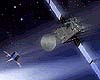 Paris, France (ESA) Aug 05, 2008
On 4 August Rosetta starts to use its cameras to visually track asteroid Steins. These observations will be used to refine the trajectory of the spacecraft relative to Steins and to adjust it, if necessary, to achieve the desired fly-by conditions: 800 km distance at closest approach on 5 September at 18:37 UTC and zero phase angle reached prior to closest approach. |
|
|

| The content herein, unless otherwise known to be public domain, are Copyright 1995-2007 - SpaceDaily.AFP and UPI Wire Stories are copyright Agence France-Presse and United Press International. ESA Portal Reports are copyright European Space Agency. All NASA sourced material is public domain. Additional copyrights may apply in whole or part to other bona fide parties. Advertising does not imply endorsement,agreement or approval of any opinions, statements or information provided by SpaceDaily on any Web page published or hosted by SpaceDaily. Privacy Statement |
 del.icio.us
 Digg
Digg Reddit
 YahooMyWeb
 Google
 Facebook