|
 |
 |
 |
 |
 |
 |
 |
 |

 |
Rosetta Performs Second Deep Space Manoeuvre
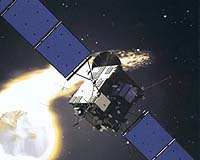
Paris, France (ESA) Oct 11, 2006 This report covers a three week peroid of active cruise and was dedicated to the preparation and execution of the second Deep Space Manoeuvre (DSM2). The manoeuvre was executed on 29 September at 02:00 UTC. Its planned magnitude was 31.791 ms-1, which corresponds to an overall burn duration of about 52 minutes. In the manoeuvre attitude, the high gain antenna could not be kept pointing at the Earth during the burn because it was in the plume zone. The high gain antenna therefore had to be moved away shortly before the start of the manoeuvre, and was pointed back after the completion of the burn. The manoeuvre was thus performed without ground contact. The manoeuvre performance was outstanding: the last orbit determination performed by Flight Dynamics using tracking data collected until 4 October indicated an over-performance of 0.279% (+88.7 mms-1) with a 1 sigma uncertainty of 0.026% (8.3 mms-1). The best estimate for the manoeuvre direction error is 0.14 degrees, with a quite large uncertainty between 0.08 and 0.25 degrees. SREM was kept continuously active in the background for the entire reporting period. All other instruments remained OFF. A total of 16 New Norcia passes of 4 to 10 hours commanding were taken during the reporting period. Ten of these passes were scheduled for tracking only. During the remaining 6, TM/TC links were connected to the control centre. In addition, 11 tracking passes of 4 hours have been taken with DSN. At the end of the reporting period (DOY 279) Rosetta was at 282.5 million km from Earth (1.89 AU; one-way signal travel time was 15 minutes 6 seconds). The distance to the Sun was 148.2 million km (0.99 AU). Deep Space Manoeuvre As part of the manoeuvre preparation, the accelerometer biases were calibrated. During the manoeuvre itself, the antenna was repositioned at -150 degrees elevation and -180 degrees azimuth. As a result, ground contact was interrupted from 272.01.46 to 272.03.36. Spacecraft - Thermal The thermal behaviour of the spacecraft is nominal and stable. It remains configured for Active Near Sun cruise (ACM1 since DOY 207/2006). On DOY 263, the TCT lines which had been spuriously declared failed on DOY 257/258 during the first thermal characterisation were manually reset to Prime software control. The temperature of the thrusters and of the high gain antenna mechanism was monitored closely during the Deep Space Manoeuvre. All temperatures remained well within their defined limits. There was some concern on the temperature of the high gain antenna mechanism during the manoeuvre because the motor was to remain active for two hours at a Sun distance of 1 AU. However, the observed temperature variations remained very moderate. The temperature of the elevation mechanism only increased from 51.6 to 53.3 degreesC, whereas the temperature of the azimuth motor increased from 45 to 51.7 degreesC. - Payload SREM remains active in the background for radiation monitoring with accumulation parameters configured for active cruise. All other instruments remained OFF during the reporting period. Future Milestones The Mars Swingby Phase formally started on 28 July. The phase includes the first payload Active Checkout (PC4) in November/December 2006, while the actual swingby will take place on 25 February 2007, followed by a Deep Space Manoeuvre in April 2007. The next short-term activity is an AOCS checkout on 11/12 October. Source: European Space Agency Community Email This Article Comment On This Article Related Links Rosetta at ESA The Iron and Ice Of Our Solar System Asteroid and Comet Mission News, Science and Technology
 Dawn Spacecraft Assembly Proceeding Well
 Los Angeles CA (SPX) Oct 10, 2006
The Dawn mission is proceeding apace as the project team continues to prepare the spacecraft for its mission. This work has proceeded smoothly despite the chaos of planets apparently coming and going from our solar system. |
|
|

| The content herein, unless otherwise known to be public domain, are Copyright 1995-2006 - SpaceDaily.AFP and UPI Wire Stories are copyright Agence France-Presse and United Press International. ESA PortalReports are copyright European Space Agency. All NASA sourced material is public domain. Additionalcopyrights may apply in whole or part to other bona fide parties. Advertising does not imply endorsement,agreement or approval of any opinions, statements or information provided by SpaceDaily on any Web page published or hosted by SpaceDaily. Privacy Statement |