|
 |
 |
 |
 |
 |
 |
 |
 |

 |
Rosetta Closing In On Earth Again For Second Gravity Boost
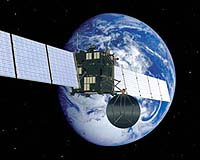
Paris, France (ESA) Nov 09, 2007 ESA's comet chaser, Rosetta, is on its way to its second close encounter with Earth on 13 November. The spacecraft's operators are leaving no stones unturned to make sure Earth's gravity gives it the exact boost it needs en route to its destination. This month's Earth swing-by is Rosetta's third major step on its 10-year journey to 67/P Churyumov-Gerasimenko. The trajectory correction manoeuvre successfully performed last month prepared ESA's Comet Chaser for the upcoming encounter. The spacecraft is now right on track to gain the right amount of energy from Earth's gravity and save fuel later on. Closest approach will take place on 13 November 2007 at 21:57 CET, at which time Rosetta will speed past at 45 000 km/h (about 12.5 km/s) relative to Earth. At this time, Rosetta will be 5301km above the Pacific Ocean, south-west of Chile, at 63 degrees 46 minutes South and 74 degrees 35 minutes West.
Why swing by Earth? The first Earth swing-by took place on 4 March 2005. On 25 February 2007 Rosetta made its closest approach to Mars, to use its gravity. The swing-by this month will be followed by the third and last swing-by, using Earth's gravity, on 13 November 2009. While the gravity-assist manoeuvre at Mars was needed to slow the spacecraft down and head back towards the inner solar system, the second Earth swing by will help Rosetta gain enough energy to reach the outer Solar System through the asteroid belt and observe asteroid Steins, one of its scientific targets. Rosetta will then head back to Earth for the last planned swing-by in November 2009. The increased energy from this Earth swing-by will help Rosetta cross the asteroid belt for a second time, observe Lutetia (its second target asteroid) and finally rendezvous with comet 67/P Churyumov-Gerasimenko. The rendezvous will take place about 4 astronomical units or 600 million km from the Sun, in 2014.
Intense activity coming up Despite this, a few experiments both on the orbiter and the Philae lander will be activated for calibration, scientific measurements and imaging. The observations are scheduled during and around the time of closest approach, from 7 Nov, 01:00 CET, to 20 Nov, 15:00 CET. Rosetta will first point to Earth to make observations of the atmosphere and the magnetosphere, including a search for shooting stars from space. It will image urban regions in Asia, Africa and Europe and then point to the Moon and obtain spectra of the illuminated Moon. Flying away after closest approach, Rosetta will image the Earth-Moon system from a distance. Rosetta will be controlled from ESA's Spacecraft Operations Centre (ESOC) in Darmstadt, Germany For more detail about Rosetta's spacecraft and scientific operations, please read the Rosetta second Earth swing-by Q and A. For the swing-by, the ESA Web portal is hosting a Rosetta swing-by blog providing frequent updates, news and information direct from the Rosetta Dedicated Control Room at ESOC. Community Email This Article Comment On This Article Related Links Rosetta ESA Spacecraft Operations Space Tourism, Space Transport and Space Exploration News
 Repair Shops For Broken DNA
 Houston TX (SPX) Nov 08, 2007
A stray bullet rips through the command center, blowing holes in vital equipment and damaging the data archives. Repair teams spring into action. The damage must be patched up quickly or the control systems could go haywire. It's literally a matter of life or death, and a decision must be made: try to fix the damage in place, or move the broken parts to the repair shop. |
|
|

| The content herein, unless otherwise known to be public domain, are Copyright 1995-2007 - SpaceDaily.AFP and UPI Wire Stories are copyright Agence France-Presse and United Press International. ESA Portal Reports are copyright European Space Agency. All NASA sourced material is public domain. Additional copyrights may apply in whole or part to other bona fide parties. Advertising does not imply endorsement,agreement or approval of any opinions, statements or information provided by SpaceDaily on any Web page published or hosted by SpaceDaily. Privacy Statement |