|
 |
 |
 |
 |
 |
 |
 |
 |

 |
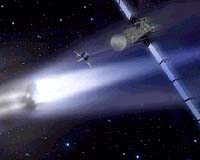
Rosetta Boot Up Continues Comet Probe Begin 10 Year Journey
Paris - Mar 10, 2004 The spacecraft and ground segment continue to operate well. All activities planned for the initial, critical phase after launch have been successfully completed ahead of schedule. In the early morning of 5 March the Mission Control Team at ESOC has moved from the Main Control Room to the Rosetta Dedicated Control Room to commence the spacecraft and payload commissioning. This early relocation of the team, just 3 days after launch, is a record at ESOC and it is seen as remarkable, considering the complexity of the Rosetta spacecraft. The 5-day launch delay, from 26 February to 2 March, has been largely recovered and the early commissioning activities are now scheduled to within 1 or 2 days of the original plan. The New Norcia ground station in Australia (35 m antenna) will support the daily operations, while the support from the ESA Kourou and NASA Deep Space Network Madrid and Goldstone ground stations has been released with the termination of the critical phase. By midday on 8 March Rosetta is already 2 million km from the Earth. The signal round-trip light-time is almost 14 seconds. Initial activation of S-band transmission, using the 2.2 m large dish antenna, commenced at 23:16 on 3 March. Successful commissioning of the S-band up and downlinks on the low and high gain antennas took place throughout the night. Following on from this, configuration of the X-band, also using the high gain antenna, took place with a downlink signal received at both the Kourou and Madrid ground stations at 13:07 UT. Termination of the S-band uplink occurred at 13:20 and X-band uplink established at 13:35. The X-band uplink was then terminated at 14:30 and uplink communications were re-established via the High Gain Antenna at S-band. By 7 March, tests of the X-band communications had been completed. These activities successfully demonstrated the nominal performance of the major communication systems, which will be critical for the mission. Due to the rapidly increasing distance between the spacecraft and the Earth, the possible data rate using the low gain antenna is already limited to 7.8 bits per second and this link will soon vanish. Using the High Gain Antenna the maximum data rate of 22 kbits per second is sustainable. The attitude control system has undergone several characterization tests, such as gyroscope calibrations and determination of the friction in the reaction wheel system. This included, for the first time, switching on all four reaction wheels simultaneously. Substantial disturbance torques acted on the spacecraft during its first few days in orbit. Over the following days these torques gradually decreased to nominal levels. The phenomenon, attributed to the outgassing of the spacecraft, diminishes with time because the spacecraft is in the high vacuum of space. Full configuration of the 25 Gbit solid-state mass memory took place on 4 March in order to support routine operations: creating data stores for all instruments and storing redundant files of application software. Activation of all memory modules for the mission is now complete. Commissioning of the power subsystem took place at the end of the Madrid pass on 4 March. All checks were successful and the power subsystem behaved as expected. The drive mechanisms of the solar array are being exercised during the early days of the flight in order to keep the solar cells perpendicular to the Sun as the spacecraft rotates. The azimuth and elevation drives, enabling the High Gain Antenna to track the Earth, have been extensively characterized. These mechanical functions are critical to the mission and they are working nominally. Editor's Note: Once Rosetta enters cruise stage SpaceDaily coverage will be suspended until the first flyby event of Earth in March 2005. Details on the many flyby events can be found here and a flash presentation of the long journey can be found here. CommunityEmail This Article Comment On This Article Related Links SpaceDaily Search SpaceDaily Subscribe To SpaceDaily Express Asteroid and Comet Mission News, Science and Technology
 Stardust Entry Path To Be Visible In Northwest
 Pasadena CA (JPL) Jan 10, 2006
On January 15, 2006, after more than 7 years and billions of miles of travel through space, NASA's Stardust spacecraft will release a 100-pound sample return capsule (SRC) to Earth with some precious cargo - pristine samples of comet and interstellar dust. |
|
|

| The content herein, unless otherwise known to be public domain, are Copyright 1995-2006 - SpaceDaily.AFP and UPI Wire Stories are copyright Agence France-Presse and United Press International. ESA PortalReports are copyright European Space Agency. All NASA sourced material is public domain. Additionalcopyrights may apply in whole or part to other bona fide parties. Advertising does not imply endorsement,agreement or approval of any opinions, statements or information provided by SpaceDaily on any Web page published or hosted by SpaceDaily. Privacy Statement |