
 |
 |
 |
 |
 |
 |
 |
 |
 |

 |
Rosella Research Could Re-Write Ring Theory
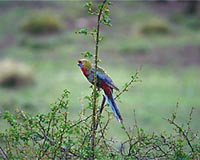
Canberra, Australia (SPX) Jul 30, 2008 Published in the prestigious journal Proceedings of the Royal Society B, the research investigates the genetic and geographical relationships between different forms of crimson rosellas and the possible ways that these forms may have arisen. Dr Gaynor Dolman of CSIRO's Australian National Wildlife Collection says there are three main colour 'forms' of the crimson rosella - crimson, yellow and orange - which originated from the same ancestral population and are now distributed throughout south eastern Australia. "Many evolutionary biologists have argued that the different forms of crimson rosellas arose, or speciated, through 'ring speciation'," she says. The ring speciation hypothesis predicts that a species that spreads to new areas may eventually join back up with itself, forming a ring. By that time, the populations at the join in the ring may be two distinct species and unable to interbreed, despite continuous gene flow, or interbreeding, between populations around the ring. "We found that in the case of crimson rosellas, their three separate genetic groups don't show a simple link to the geographical distribution of the colour forms," Dr Dolman says. "For example, orange Adelaide and crimson Kangaroo Island rosellas are separated by 15km of ocean but are genetically similar. Conversely, genetic dissimilarity was found in the geographically linked yellow and orange populations in inland south eastern Australia. "We rejected the ring hypothesis because it predicts only one region of genetic dissimilarity, which should occur at the geographical location of the join in the ring, around the headwaters of the Murray and Murrumbidgee Rivers. "However, it is possible that crimson rosellas formed a ring at some stage in their evolutionary history, but that the evidence has been lost through climatic or environmental changes," she says. Wildlife genetic research of this kind is increasing our understanding of the biogeography and evolution of Australia's terrestrial vertebrates, helping Australia sustainably manage its biodiversity and ecosystem functions in the face of land use and climate change. This work involved a team of researchers from CSIRO, Deakin University and the South Australian Museum. Community Email This Article Comment On This Article Share This Article With Planet Earth
Related Links Australian National Wildlife Collection Darwin Today At TerraDaily.com
 Bacteria Reveal Secret Of Adaptation At Evolution Canyon
 London, UK (SPX) Jul 30, 2008
Bacteria living on opposite sides of a canyon have evolved to cope with different temperatures by altering the make-up of their 'skin', or cell membranes. Scientists have found that bacteria change these complex and important structures to adapt to different temperatures by looking at the appearance of the bacteria as well as their genes. |
|
|

| The content herein, unless otherwise known to be public domain, are Copyright 1995-2007 - SpaceDaily.AFP and UPI Wire Stories are copyright Agence France-Presse and United Press International. ESA Portal Reports are copyright European Space Agency. All NASA sourced material is public domain. Additional copyrights may apply in whole or part to other bona fide parties. Advertising does not imply endorsement,agreement or approval of any opinions, statements or information provided by SpaceDaily on any Web page published or hosted by SpaceDaily. Privacy Statement |
 del.icio.us
 Digg
Digg Reddit
 YahooMyWeb
 Google
 Facebook