|
 |
 |
 |
 |
 |
 |
 |
 |

 |
"Root Cause" Declared For Delta 4 Heavy Demo Mission
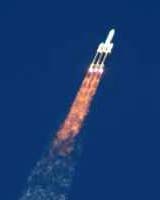
Los Angeles AFB CA (SPX) Mar 18, 2005 Boeing and the Air Force, supported by The Aerospace Corporation, as part of their on-going investigation, have identified the root cause for the premature Main Engine Cut-Off (MECO) on the Delta IV Heavy Lift Vehicle (HLV) demonstration mission that was launched Dec. 21, 2004. The root cause of the anomaly has been identified as a fluid cavitation within the liquid oxygen feed system. Analyses show that the cavitation originated at the entrance of the propellant feedline, where a filtration screen and turning elbow restrict the propellant flow as it accelerates leaving the tank. This feedline restriction has been present in all previous Delta IV flights, but the unique combination of vehicle acceleration, liquid level in the tank, and propellant flow rate for this mission, reduced the fluid pressure enough to enable the creation of gaseous oxygen at this location as the tanks emptied. Further draining of the liquid oxygen tank worsened the conditions at the feedline inlet, causing the cavitation effect to extend down the feedline until it reached the liquid depletion sensors and caused them to momentarily toggle dry. This action was sensed by the flight computer, which initiated the sequence to throttle-down and shut off the main engines as it is programmed to do. Flight data shows that sufficient propellant remained in the tank to complete the planned first stage burn time. "This investigation has followed a deliberate process to ensure no potential causes were missed," stated Major Rod Houser, investigation lead for the Air Force. "The Fault Tree analysis, which we've used to categorize potential causes in propulsion, avionics, structures, and flight environments, has ruled out 49 of the 50 fault tree branches. Our attention is now focused on the final open branch of the fault tree dealing with cavitation within the liquid oxygen feed system." Over the past eight weeks, a team of experts led by Mark Baldwin, Boeing's Delta Propulsion Analysis Manager, has analyzed scenarios where a cavitation disturbance of the liquid oxygen flow could cause the liquid to change to gaseous oxygen in the area of the engine cut-off sensors. "Our team used computer models to simulate the flow in the liquid oxygen feedline between the bottom of the propellant tank and the engine cut-off sensors, approximately five feet downstream," stated Baldwin. "The team enhanced its simulation models incrementally to include the more complex internal features of the liquid oxygen tank and feedline. Simulation runs have been completed with the higher fidelity models, resulting in an increasingly accurate simulation of the flow conditions experienced during the Heavy demonstration flight. "These conditions correlated well with measurements taken by the sensors on board the vehicle," he concluded. The investigation team has also been able to analyze and rule out other forms of unanticipated tank-draining phenomena, which could have pulled oxygen vapor into the feedline from above the liquid surface in the tank. Scenarios for such a "vapor pull-through" have been analyzed by computer simulation and other techniques and shown to be highly unlikely, even for extreme cases of whirlpooling or "sloshing" of the liquid oxygen inside the tank. Engineering experts researched these and all of the other 49 "closed" fault tree branches to determine they were not credible as causes of the anomaly. All closures were thoroughly documented, citing multiple sources of supporting evidence drawn from flight data, a range of focused technical analyses, and computer simulation results. The Boeing Company has started to take steps toward corrective actions for the entire Delta IV fleet. Additional computer simulations that fully analyze the liquid oxygen flow between the bottom of the propellant tank and the engine cut-off sensors will continue through March to help the engineers select and validate corrective actions. A final executive review board will then be held to officially close the anomaly investigation. Community Email This Article Comment On This Article Related Links Boeing The Aerospace Corporation Air Force SpaceDaily Search SpaceDaily Subscribe To SpaceDaily Express Rocket Science News at Space-Travel.Com
 Successful First Test For Vega's Zefiro 9 Engine
 Paris, France(ESA) Dec 28, 2005
Flames, smoke and a deafening noise accompanied the first firing test of Vega's Zefiro 9 third-stage solid rocket motor. A first examination of the data indicates that everything went well at the test carried out yesterday at Salto de Quirra in southeast Sardinia. |
|
|

| The content herein, unless otherwise known to be public domain, are Copyright 1995-2006 - SpaceDaily.AFP and UPI Wire Stories are copyright Agence France-Presse and United Press International. ESA PortalReports are copyright European Space Agency. All NASA sourced material is public domain. Additionalcopyrights may apply in whole or part to other bona fide parties. Advertising does not imply endorsement,agreement or approval of any opinions, statements or information provided by SpaceDaily on any Web page published or hosted by SpaceDaily. Privacy Statement |