|
 |
 |
 |
 |
 |
 |
 |
 |

 |
Rogue Rwandan Elephant Lumbers On With US Travel Warning
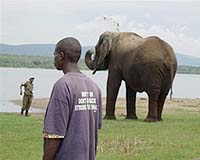
Akagera National Park, Rwanda (AFP) Dec 9, 2005 Half-submerged in a lake in eastern Rwanda stands Mutware, a rogue elephant believed to be the only single animal ever to have a prompted a security warning from the US government. Wallowing serenely in the muddy waters of Lake Ihema in the central African country's Akagera National Park, the placid demeanor of the 37-year-old bull belies his reputation as an aggressive beast bent on destruction. Yet, it is Mutware, "the chief", who has wrecked at least three vehicles in recent months, terrorizing if not injuring their occupants and drawing the attention of worried US diplomats who complained to the Rwandan government about his behavior. Earlier this year, Washington's embassy in Kigali -- a mission normally more concerned with threats posed by rebel groups in Africa's volatile Great Lakes region -- took the unusual step of issuing a formal alert for Mutware. "Recently, this elephant has displayed more aggressive behavior towards visitors to the point that actual charging and physical contact with vehicles has occurred," it said in an April warning that remains in force. "The embassy has notified the Rwandan Office of Tourism and National Parks and expressed our concerns about these incidents," it said, advising US citizens "to exercise extra caution" in Akagera. Park rangers defend the elephant, saying that at least two of the groups whose cars were attacked refused advice to travel with guides who could have steered them clear of the jumbo. They say Mutware's bouts of aggression have more to do with the elephant's loneliness and inability to attract a mate than any innate hatred for humans or the strange motorized vehicles in which they ride. "It's only in the mating season that he gets aggressive and that's because he's solitary and has no female," says ranger James Muhizi. "The first sign he's feeling aggressive is that he flaps his ears," he added. "The second is that he sends clouds of dust up into the air and the third sign is when he stamps his foot on the ground. "When that happens you'd better get out of the area," Muhizi told AFP. Only one man is thought to know how to calm Mutware: a slightly eccentric 54-year-old veteran ranger whose methods seem more like those of an elephant handler at a circus than a game warden. Calling the towering elephant "cutie-pie" and bribing him with sugar and the odd bottle of fizzy drink, Boniface Zakamwita can persuade Mutware to get in or out of the water, turn around or stand still. "When he first arrived here I was only 20 and he barely came up to my chest," Zakamwita says of the pachyderm that has grown so large he must now jump just to throw sugar into the elephant's mouth. In the halcyon years that followed, Mutware led the life of a fulfilled elephant, consorting with two females who bore him two calves, he recalls. But one day, the females decamped for greener pastures, enraging Mutware who unsuccessfully fought the dominant males who had won their attention, losing his tusks in the battle, Zakamwita says. With his right tusk completely torn out and left one reduced to a mere stump, Mutware was left ill-equipped to find another female among the estimated 100 elephants that frequent Akagera's several lakes, he says. Boniface Zakamwita thus became Mutware's lone companion. Then, in 1994, Rwanda erupted into bloody violence as extremists in the country's Hutu majority went on a 100-day killing spree, slaughtering some 800,000 people, mainly minority Tutsis, and sending Zakamwita, a Hutu, into hiding. It was during his absence and the chaos of the post-genocide years that Mutware may have picked up animosity towards humans as he was shot at by soldiers and speared by villagers when he wandered outside the park's ill-defined boundaries in search of food. Zakamwita returned to Rwanda from self-imposed exile in Tanzania where he lost his wife and several children several years ago but it was only in 2004 that he resumed his guardianship of Mutware in Akagera. It was then that park authorities - convinced that Zakamwita was the only person who stood a chance of keeping the elephant in line -- went looking for him and found him in a nearby village. Despite the dangers posed by Mutware and his difficult behavior, Zakamwita says the relationship has been mutually beneficial. "When Mutware got caught in a trap he managed to break free and came straight to me so I could take the wire out of his flesh," he says, adding: "With the money I get from looking after Mutware, I've been able to find a new wife."
Source: Agence France-Presse Community Email This Article Comment On This Article Related Links SpaceDaily Search SpaceDaily Subscribe To SpaceDaily Express Darwin Today At TerraDaily.com
 Scientists Sequence DNA Of Woolly Mammoth
 Hamilton ON (SPX) Dec 19, 2005
Experts in ancient DNA from McMaster University (Canada) have teamed up with genome researchers from Penn State University (USA) for the investigation of permafrost bone samples from Siberia. The project also involved paleontologists from the American Museum of Natural History (USA) and researchers from Russia, the United Kingdom, France, and Germany. |
|
|

| The content herein, unless otherwise known to be public domain, are Copyright 1995-2006 - SpaceDaily.AFP and UPI Wire Stories are copyright Agence France-Presse and United Press International. ESA PortalReports are copyright European Space Agency. All NASA sourced material is public domain. Additionalcopyrights may apply in whole or part to other bona fide parties. Advertising does not imply endorsement,agreement or approval of any opinions, statements or information provided by SpaceDaily on any Web page published or hosted by SpaceDaily. Privacy Statement |