|
 |
 |
 |
 |
 |
 |
 |
 |

 |
Rockhard Stardust
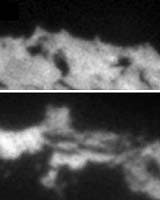
Moffet Field CA - Jun 21, 2004 New photographs of the comet Wild-2 show an unusual and surprising landscape. Scientists thought most comets were "fluffy" snowballs - piles of icy rubble that were loosely bound together. But Wild-2 has a solid, cohesive surface carved into lofty pinnacles, deep canyons and broad mesas. "It's completely unexpected. We were expecting the surface to look more like it was covered with pulverized charcoal," says Donald Brownlee, a University of Washington astronomy professor and Stardust's principal investigator. Brownlee is lead author of one of the four Stardust papers appearing in the June 18 issue of the journal Science. When the Stardust spacecraft passed within 236 kilometers (147 miles) of the comet Wild 2 On January 2, 2004, it encountered a storm of dust particles traveling at over 6 times the speed of a bullet. The spacecraft collected some of the hundreds of thousands of particles that impacted each second, and this sample will be returned to Earth in January 2006. While Stardust's mass spectrometer analyzed the composition of particles and the dust flux monitor measured the particle impact rate, a camera onboard the spacecraft clicked away, taking many high-resolution photographs of the comet's nucleus. The sculpted pinnacles seen in the Stardust images are as tall as 100 meters (328 feet). "We assume they are erosional features similar to the pinnacles on Earth," says Brownlee. "Think of Monument Valley - those pinnacles and mesas are sitting up there because the regions surrounding them have been eroded away. If that's correct for the comet, that means the comet has lost something on the order of 100 meters of the surface over its lifetime." The comet also has craters more than 150 meters deep (492 feet). Some craters have a round central pit surrounded by rough terrain, while others have a flat floor and steep sides. Two large craters near the polar region of the comet have been named Right Foot and Left Foot. Because of the low gravity, the craters on Wild-2 are not ringed by powdery debris like more typical impact craters. Dozens of jets of gas and dust shoot out in all directions from the comet at hundreds of kilometers per hour. Stardust was buffeted by some of these violent jets as it passed by the nucleus. The jets may form as the heat of the sun causes ice to turn directly into a gas without going through a liquid phase (a process known as "sublimation"). Wild-2 formed in the Kuiper belt region, which is located roughly 30 to 100 AU from the sun. Before 1974, the comet orbited from Jupiter to just past Uranus. But a close encounter with Jupiter altered the comet's orbit, so it now swings between the orbits of Mars and Jupiter. But Wild-2 could have flipped back and forth many times over billions of years, sometimes orbiting closer in the solar system, and other times having a more distant orbit. Comets may have played a major role in the origin of life on Earth, delivering a significant share of the Earth's water as well as carbon-rich organic compounds. When Stardust's Sample Return capsule containing the comet particles arrives on Earth in 2006, it will be sent to NASA's Johnson Space Center in Houston for analysis. Because comets are composed of ice, dust, and gas - the building blocks of the solar system - particles collected from a comet may be able to tell us something about how the solar system formed. There are two more comet missions currently planned. NASA's Deep Impact mission will visit the comet Tempel 1 on July 4, 2005. The European Space Agency's Rosetta mission launched in March of this year and will reach the comet Churyumov-Gerasimenko in November 2014. Community Email This Article Comment On This Article Related Links Stardust at JPL SpaceDaily Search SpaceDaily Subscribe To SpaceDaily Express Asteroid and Comet Mission News, Science and Technology
 Stardust Entry Path To Be Visible In Northwest
 Pasadena CA (JPL) Jan 10, 2006
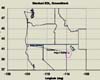
On January 15, 2006, after more than 7 years and billions of miles of travel through space, NASA's Stardust spacecraft will release a 100-pound sample return capsule (SRC) to Earth with some precious cargo - pristine samples of comet and interstellar dust. |
|
|

| The content herein, unless otherwise known to be public domain, are Copyright 1995-2006 - SpaceDaily.AFP and UPI Wire Stories are copyright Agence France-Presse and United Press International. ESA PortalReports are copyright European Space Agency. All NASA sourced material is public domain. Additionalcopyrights may apply in whole or part to other bona fide parties. Advertising does not imply endorsement,agreement or approval of any opinions, statements or information provided by SpaceDaily on any Web page published or hosted by SpaceDaily. Privacy Statement |