|
 |
 |
 |
 |
 |
 |
 |
 |

 |
RocketCam Will Take You Along For The Rendezvous
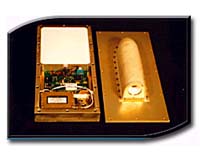
Pasadena - Oct 11, 2002 In what is expected to be a growing trend in the space business, a RocketCam Imaging System will provide live, color video from an unmanned spacecraft as part of the NASA-funded technology-demonstration mission planned for 2004. During the brief yet pioneering DART mission, two unmanned spacecraft will rendezvous in low Earth orbit with little if any human guidance, proving out a new space-operations capability needed for several types of future missions. The imaging system to be used on DART will be similar to the RocketCam system demonstrated on October 7th for NASA's Space Shuttle fleet, when the first-ever onboard live video of a shuttle launch was delivered to a worldwide audience as the orbiter Atlantis lifted off and climbed to orbit for a rendezvous with the International Space Station. The contract between RocketCam's exclusive supplier Ecliptic Enterprises Corporation and DART prime contractor Orbital Sciences Corporation (NYSE:ORB) started this week. This is Ecliptic's first order for a RocketCam system designed to be used on a spacecraft. Orbital's customer for the DART project is NASA's Marshall Space Flight Center in Huntsville, AL. Each Ecliptic RocketCam generates live, full-color video from onboard its host platform, which is then transmitted to receiving equipment on the ground for subsequent distribution to launch control centers, technical and management audiences, media outlets and the public. The Demonstration of Autonomous Rendezvous Technology (DART) project is part of NASA's Space Launch Initiative (SLI) to research and develop technologies that will make space travel safer and more affordable. While NASA has performed rendezvous and docking missions in the past, astronauts have always piloted the spacecraft. The technologies to be demonstrated by DART represent a critical step for establishing an autonomous rendezvous capability for the United States and will lay the groundwork for reusable manned and unmanned launch system operations. Future applications of this technology include cargo delivery and space-taxi operations for the International Space Station (ISS) and other on-orbit activities such as satellite retrieval and servicing missions. During mission operations in low Earth orbit, the RocketCam system will capture and transmit live, color video from the DART spacecraft to mission controllers on the ground, who will use the video stream to verify accomplishment of several mission objectives. The DART spacecraft will be launched in 2004 aboard an Orbital Pegasus� winged rocket and inserted into a circular parking orbit, and then will perform a series of orbit transfers to arrive at a point near a target satellite using state-of-the-art GPS-relative navigation techniques. Using the vehicle's main instrument, the Advanced Video Guidance Sensor (AVGS), DART will then approach the target satellite to within a distance of 5 meters and perform various station-keeping maneuvers. Finally, DART will demonstrate a collision avoidance maneuver, then depart the vicinity and transition to its final orbit. The entire sequence will be accomplished under autonomous control within a few days after launch, and most key events will be covered and verified by the RocketCam video. RocketCam Imaging Systems, which have been 100% successful on a total of 21 rocket launches to date, are employed regularly by The Boeing Company on its Delta II and Delta III rockets and by Lockheed Martin Astronautics on its Atlas 2, Atlas 3, Atlas 5 and Titan IV rockets. The next scheduled use of RocketCam will be on the early November inaugural launch of Boeing's large Delta IV rocket, which will orbit a communications satellite for Paris-based Eutelsat. "The nearly flawless operational history of Ecliptic's RocketCam products in the launch systems arena was an important factor in our selection of Ecliptic for this spacecraft application," said Tim Rumford, DART Program Manager at Orbital. "We're also pleased with the relative simplicity of the RocketCam interfaces, Ecliptic's responsiveness and relatively rapid delivery schedule." Said Ecliptic's CEO Rex Ridenoure: "This represents the accomplishment of a key milestone in Ecliptic's business strategy to expand applications of our RocketCam product line. We expect this to be one of many spacecraft projects in coming years to endorse the concept of employing RocketCams for viewing critical mission functions and sequences." Community Email This Article Comment On This Article Related Links Ecliptic Enterprises SpaceDaily Search SpaceDaily Subscribe To SpaceDaily Express Space Technology News - Applications and Research
 TeleRay Mobile Sat TV Antenna For Japan Auto Market
 Las Vegas CA (SPX) Jan 5, 2006
RaySat has introduced TeleRay, the world's smallest satellite TV vehicle antenna, into the domestic Japanese automotive market. |
|
|

| The content herein, unless otherwise known to be public domain, are Copyright 1995-2006 - SpaceDaily.AFP and UPI Wire Stories are copyright Agence France-Presse and United Press International. ESA PortalReports are copyright European Space Agency. All NASA sourced material is public domain. Additionalcopyrights may apply in whole or part to other bona fide parties. Advertising does not imply endorsement,agreement or approval of any opinions, statements or information provided by SpaceDaily on any Web page published or hosted by SpaceDaily. Privacy Statement |