
 |
 |
 |
 |
 |
 |
 |
 |
 |

 |
Robots may enhance disabled people's lives
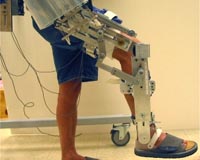
Rochester, N.Y. (UPI) Aug 11, 2008 A U.S. study foresees robots as improving both the quality and flexibility of the lives of people with disabilities that affect the use of their limbs. The robotics engineering research, sponsored by The National Science Foundation, utilized physiological information -- called bio-signals -- produced by the human body to improve external assistive devices called orthoses that help stroke or spinal cord injury patients regain the use of their arms and legs. "The data collected through this project will assist designers and engineers in developing more sophisticated assistive aids for individuals suffering from various neuromuscular diseases and musculoskeletal injuries," said Rochester Institute of Technology Assistant Professor Edward Brown. He said a robotic orthosis can take advantage of an individual's residual strength and any remaining physiological information in their limbs, such as an electromyographic signal produced in muscles. That could ultimately assist muscular dystrophy patients in regaining significant use of there limbs. "Better orthotic technologies could ultimately help people suffering from this disease (to) greatly enhance the quality of their life," Brown says. The project also included scientists from the Georgia Institute of Technology and Georgetown University. Community Email This Article Comment On This Article Share This Article With Planet Earth
Related Links All about the robots on Earth and beyond!
 Europe And Japan Join Forces To Map Out Future Of Intelligent Robots
 Paris, France (SPX) Jul 31, 2008
The field of robotics could be poised for a breakthrough, leading to a new generation of intelligent machines capable of taking on multiple tasks and moving out of the factory into the home and general workplace. |
|
|

| The content herein, unless otherwise known to be public domain, are Copyright 1995-2007 - SpaceDaily.AFP and UPI Wire Stories are copyright Agence France-Presse and United Press International. ESA Portal Reports are copyright European Space Agency. All NASA sourced material is public domain. Additional copyrights may apply in whole or part to other bona fide parties. Advertising does not imply endorsement,agreement or approval of any opinions, statements or information provided by SpaceDaily on any Web page published or hosted by SpaceDaily. Privacy Statement |
 del.icio.us
 Digg
Digg Reddit
 YahooMyWeb
 Google
 Facebook