|
 |
 |
 |
 |
 |
 |
 |
 |

 |
Robots Embedded At School In Quest To Bond With Humans
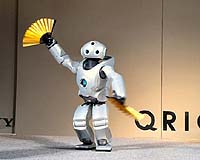
Tokyo, (AFP) Apr 16, 2006 Playtime over, a toddler says nighty-night and spreads a blanket on the floor on top of his silver-colored friend. It is an everyday scene at one US nursery school, where robots are immersed among children to find out what it takes for machines and humans to develop long-term relationships. The experiment jointly run by Sony is revealing that children, with their open minds, can welcome and even develop emotions toward the robots, leading to new commercial possibilities as machines become smarter and friendlier. "We adults tend to ask children if it is a toy or a human being, but they are free of such established categorization," says researcher Fumihide Tanaka, who the dozen toddlers fondly call "IC", as in integrated circuit chip. "When I saw a personal computer for the first time, I asked if it was a television set," the 33-year-old researcher says. "If intelligent-machine technology is successfully developed, a century later people will see the concept just as common sense. This is natural as we are living in a different era now." While Sony is undergoing business restructuring and has no plans to develop new models of its iconic QRIO humanoid or AIBO robodog, it is continuing to study artificial intelligence to apply in future electronic products. Tanaka, part of Sony Intelligence Dynamics Laboratories, has been working on the project jointly with the University of California at San Diego, led by Machine Perception Laboratory director Javier Movellan. The children, aged up to 24 months, started spending one hour every day with a 58-centimeter (23-inch) tall Sony biped in March last year at a San Diego school. "Humans are sure to have innate ways to communicate without using a language. We can see this better in children as adults depend on languages," says Tanaka during a brief visit back to Japan. "A great characteristic of this project is that we don't invite children to come over to our laboratory but we go to them," he says. Tanaka remote-controls the robot from a hidden place for some 80 percent of the immersion sessions, with the humanoid moving on its own for the rest of the time. In one experiment, researchers brought in the robot to take part in the children's dance sessions and found that the toddlers would spend longer in the room if the humanoid was among them. On average, toddlers would stay in the room for twice as long when the robot was around. Tanaka says researchers are increasingly convinced that children consider the robot not a toy or a living human being but "something between the two", a difficult idea for adults to understand. To contrast with the biped, researchers also gave the toddlers a simple toy that looked like a robot but cannot move by itself. The toy, named Robby, was handled roughly and constantly shoved to the ground -- behavior the toddlers would not show to their beloved walking, dancing humanoid. Children initially stayed away from the biped out of caution but gradually warmed to it, hugging the robot and otherwise showing affection. Initially the robot would often fall over due to inconsiderate treatment. But after one to two months, the children would help the robot get back to its feet. Within three months, the toddlers would never allow the robot to fall. "They are adapting themselves to the robot and empathizing with it, although nobody teaches them to do so," Tanaka says. With the humanoid becoming a playmate, another robot, RUBI, which runs on a wheel with a TV panel in its belly, joined the class in April 2005 as a teaching assistant. Robots are increasingly being put to practical use in Japan, which has a rapidly aging population, ranging from serving as security guards to companions for the elderly. The project involving the children could help researchers develop more sophisticated robots. Human brains are "very good at handling uncertainty and timing in everyday life, which is very difficult for the current generation of robots", says Movellan, the project head. "We feel it is very important to understand the problem of real-time social interaction," he says.
Source: Agence France-Presse Community Email This Article Comment On This Article Related Links Robots at SpaceDaily All about the robots on Earth and beyond!
 Friendly Robots Want To Do Your Chores
 Tel Aviv, Israel (UPI) Apr 04, 2006
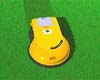
Slobs and housework-haters rejoice: If one company has its way, in the near future there will be robots to set the dinner table, clear it after dinner, shovel snow and mop the floor. In short, the robots will "move in and around the home, doing the mundane tasks that people don't like to do anymore," said Friendly Robotics Chief Executive Officer Udi Peless. |
|
|

| The content herein, unless otherwise known to be public domain, are Copyright 1995-2006 - SpaceDaily.AFP and UPI Wire Stories are copyright Agence France-Presse and United Press International. ESA PortalReports are copyright European Space Agency. All NASA sourced material is public domain. Additionalcopyrights may apply in whole or part to other bona fide parties. Advertising does not imply endorsement,agreement or approval of any opinions, statements or information provided by SpaceDaily on any Web page published or hosted by SpaceDaily. Privacy Statement |