|
 |
 |
 |
 |
 |
 |
 |
 |

 |
Robots Dive Into Student Competition
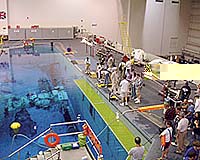
Houston TX (SPX) Aug 29, 2005 Overcoming underwater was the name of the game at Johnson Space Center's (JSC) Neutral Buoyancy Laboratory (NBL) the third weekend in June as some 400 students from across North America competed in the fourth annual national competition for student-built underwater remotely operated vehicles (ROV). Forty-two student teams designed, built and operated the underwater robots that competed June 17-19 at the Sonny Carter Training Facility. The event, organized by the Marine Advanced Technology Education (MATE) Center and the Marine Technology Society's ROV Committee, is designed to help students develop technical, problem solving, and teamwork skills that will help them in future careers in ocean and space science, engineering and exploration. Every year, the competition challenges students to develop undersea and space ROV technology that can move, grapple, carry, retrieve, install, sample and measure. ROVs come in two classes and all shapes and sizes. Some are made of PVC, chicken wire, kitchen tongs and foam pool "noodles" for buoyancy. Controlled and powered through tethers, they are guided by topside student pilots using only video images from the ROVs onboard cameras to "fly" the vehicle and perform tasks. "The goal this year is to help you to see the similarities between ocean and space environments and how technology developed for ocean work can be used in space and vice versa," Jill Zande, MATE competition coordinator told students at the competition's June 17 kick-off ceremony held at Space Center Houston. "You came to compete and many of you have your eye set on first place," Dr. Adena Williams Loston, NASA chief education officer, told the competitors. "None of that matters to NASA. I'm here because all of you are winners to us. It's competitions like these that we hope will inspire you to pursue careers in mathematics, science, technology and engineering." The scenario faced by the larger Explorer-class robots this year involved a mission to the waters that lie beneath the Jupiter moon Europa's ice-crusted surface. The robots had to descend through a simulated ice hole to repair a communications link with a science package, retrieve data probes, take a fluid sample and measure the temperature of an underwater vent. Explorer team robots competed on the floor of the NBL, a full 40 feet below the surface. First place went to the Eastern Edge Robotics Team, Mt. Pearl, Newfoundland, Canada. Second place went to Monterey Peninsula College, Calif. and third to Carl Hayden High School, Phoenix, Ariz. The smaller "Ranger" teams had to cap an old oil well, repair a damaged subsea telecommunications cable and install a new instrument on the Hubble space telescope while submerged on a platform 15 feet below the surface. High Technology High School, Lincroft, N.J., won top honors. Second and third places went to two Texas teams from the Career and Technology Education Center, Humble, and Pasadena Memorial High School, respectively. "It was a great experience," said Michael of the University of San Diego High School in California. "We learned a lot about teamwork and cooperation among other practical and valuable skills, like soldering." "It's definitely worth the work and long hours," said Sayre of the Alaska Polar Submersibles Team. "It really teaches you how to work with other people and how to meet deadlines. It was a great way to apply what you learn in class." During the opening ceremony at Space Center Houston, the students also took part in an interactive event with "aquanauts" 60 feet underwater inside the National Oceanic and Atmospheric Administration's (NOAA) Aquarius underwater habitat off Key Largo, Fla. Astronaut Clay Anderson, who lived aboard Aquarius as part of the NASA Extreme Environment Mission Operations project, was at the ceremony in person to explain how the only underwater laboratory in the world is being used to train astronauts preparing for long-duration space missions. "Every element of the competition worked very well," said Lisa Spence, an NBL fight lead for the Mission Operations Directorate, who planned and coordinated the event with MATE and other JSC organizations. "I saw a lot of interaction between the volunteers, a lot of information sharing with the students and very good comments on how friendly, helpful and professional all of our folks were." Almost four dozen volunteers from JSC, all dressed in bright yellow NBL T-shirts, helped keep things running smoothly. Spence said JSC plans to host next year's regional competition, and that MATE is beginning discussions for having the NBL host next year's national competition. The event is supported by funds, equipment and facilities, donated by the National Science Foundation and NOAA's Office of Ocean Exploration and many other space and ocean-related organizations. "It's just a ton of fun to see the creativity and energy that these kids have," said Spence, who, along with Alvin Community College, organized the past three Texas Regional competitions. "It's a great opportunity for those of us who work at the NBL to showcase our facility, especially to a group of kids who have the potential to be our co-workers in a few years." Community Email This Article Comment On This Article Related Links SpaceDaily Search SpaceDaily Subscribe To SpaceDaily Express All about the robots on Earth and beyond!
 Robo-Rodent Gets Touchy-Feely
 Hamburg, Germany (SPX) Nov 16, 2005
Robots that 'feel' objects and their texture could soon become a reality thanks to the innovative and interdisciplinary research of the AMouse, or artificial mouse, project. |
|
|

| The content herein, unless otherwise known to be public domain, are Copyright 1995-2006 - SpaceDaily.AFP and UPI Wire Stories are copyright Agence France-Presse and United Press International. ESA PortalReports are copyright European Space Agency. All NASA sourced material is public domain. Additionalcopyrights may apply in whole or part to other bona fide parties. Advertising does not imply endorsement,agreement or approval of any opinions, statements or information provided by SpaceDaily on any Web page published or hosted by SpaceDaily. Privacy Statement |