|
 |
 |
 |
 |
 |
 |
 |
 |

 |
Robotic Whiskers Can Sense Three-Dimensional Environment
Evanston IL (SPX) Dec 27, 2006 Many mammals use their whiskers to explore their environment and to construct a three-dimensional image of their world. Rodents, for example, use their whiskers to determine the size, shape and texture of objects, and seals use their whiskers to track the fluid wakes of their prey. Two Northwestern University engineers have been studying the whisker system of rats to better understand how mechanical information from the whiskers gets transmitted to the brain and to develop artificial whisker arrays for engineering applications. Mitra J. Hartmann, assistant professor of biomedical engineering and mechanical engineering in the McCormick School of Engineering and Applied Science, and Joseph H. Solomon, one of Hartmann's graduate students, have now developed arrays of robotic whiskers that sense in two dimensions, mimicking the capabilities of mammalian whiskers. They demonstrate that the arrays can sense information about both object shape and fluid flow. A paper about the arrays, which may find application on assembly lines, in pipelines or on land-based autonomous rovers or underwater vehicles, was published in the Oct. 5 issue of the journal Nature. "We show that the bending moment, or torque, at the whisker base can be used to generate three-dimensional spatial representations of the environment," said Hartmann. "We used this principle to make arrays of robotic whiskers that in many respects closely replicate rat whiskers." The technology, she said, could be used to extract the three-dimensional features of almost any solid object. Rat whiskers move actively in one dimension, rotating at their base in a plane roughly parallel to the ground. When the whiskers hit an object, they can be deflected backwards, upwards or downwards by contact with the object. The mechanical bending of the whisker activates many thousands of sensory receptors located in the follicle at the whisker base. The receptors, in turn, send neural signals to the brain, where a three-dimensional image is presumably generated. Hartmann and Solomon showed that their robotic whiskers could extract information about object shape by "whisking" (sweeping) the whiskers across a small sculpted head, which was chosen specifically for its complex shape. As the whiskers move across the object, strain gauges sense the bending of the whiskers and thus determine the location of different points on the head. A computer program then "connects the dots" to create a three-dimensional representation of the object. The researchers also showed that a slightly different whisker array -- one in which the whiskers were widened to provide more surface area -- could determine the speed and direction of the flow of a fluid, much like a seal tracks the wake of prey. Community Email This Article Comment On This Article Related Links Northwestern University All about the robots on Earth and beyond!
 Researchers Demonstrate Direct Brain Control Of Humanoid Robot
 Seattle WA (SPX) Dec 18, 2006
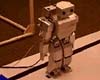
A classic science-fiction scene shows a person wearing a metal skullcap with electrodes sticking out to detect the person's thoughts. Another sci-fi movie standard depicts robots doing humans' bidding. Now the two are combined, and in real life: University of Washington researchers can control the movement of a humanoid robot with signals from a human brain. |
|
|

| The content herein, unless otherwise known to be public domain, are Copyright 1995-2006 - SpaceDaily.AFP and UPI Wire Stories are copyright Agence France-Presse and United Press International. ESA PortalReports are copyright European Space Agency. All NASA sourced material is public domain. Additionalcopyrights may apply in whole or part to other bona fide parties. Advertising does not imply endorsement,agreement or approval of any opinions, statements or information provided by SpaceDaily on any Web page published or hosted by SpaceDaily. Privacy Statement |