|
 |
 |
 |
 |
 |
 |
 |
 |

 |
Robotic Science Station Opens Dec 3
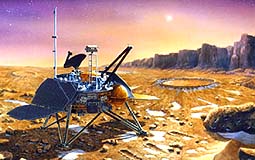
Tucson - November 29, 1999 - Days from now, scientists will witness their experiments complete an 11-month, 137-million-mile space trip to Mars. On Friday, Dec. 3, NASA's Mars Polar Lander is to make a first-ever landing near a pole of the Red Planet, the south pole. Landing begins the first martian day of the 3-month mission, or "sol 0." The spacecraft carries a science payload package called MVACS, or the Mars Volatiles and Climate Surveyor. MVACS is to search for water and other gases that once filled a thick martian atmosphere. Scientists have convincing evidence that sometime in Mars' geological past, liquid water catastrophically flooded the planet. But today, the martian atmosphere is so thin that if temperatures were to reach above freezing, water would instantly boil away. What caused the climate to drastically change, and what happened to the atmospheric gases, the water and carbon dioxide -- the "volatiles"? Past atmospheric gases may be locked as ice, salt and other compounds in the soil. MVACS scientists will dig for the answers. Their research tools were designed and built at the University of Arizona by Lunar and Planetary Laboratory (LPL) researchers, students and international colleagues. Soon after landing, a UA-built multi-spectral, stereoscopic camera called Surface Stereo Imager (SSI) will begin its photographic survey of the landing site. Peter H. Smith of LPL heads the group who built SSI. This camera is identical to the Pathfinder camera that landed on Mars on July 4, 1997 and took more than 16,500 images for what is widely regarded as one of the most successful and publicly popular missions in NASA history. Smith is sure to be a participant in some of the first news briefings from the NASA Jet Propulsion Laboratory (JPL) in Pasadena, which is managing the mission. According to current plans, which are subject to change, payload commanders will flex a six-foot, six-inch robotic digging arm on sol 4 or sol 5 (Dec. 7 or 8). A sol, or day on Mars, is 24 hours and 37 minutes. Smith, his team and colleagues at Germany's Max Planck Institute for Aeronomy designed and built RAC, or the Robotic Arm Camera, on the wrist of the robotic arm. It will take close-up views of the icy martian terrain. This camera is able to resolve an image of a single human hair from a distance of half an inch. Researchers will see detail in good-sized chunks of gravel down to fine grains of sand. RAC will inspect trench walls as the robotic arm digs. Lamps mounted on this camera shine in red, blue and green from several directions. Without the colored lights, the scientists would see only black-and-white images. With them, they will see color as well as structure of the soil. While the 1997 Mars Pathfinder camera cost $5 million, SSI and RAC together were built for $2.7 million. They and the JPL-built robotic arm are integral to TEGA, the Thermal and Evolved Gas Analyzer investigation headed by William V. Boynton. Boynton, UA professor of planetary sciences, originally conceived the idea for the TEGA 16 years ago, while thinking about ways to measure ices in a comet. It features the tiniest out-of-this world ovens that ever cooked alien soil. On sol 5 (Dec. 8) or after, the robotic arm will begin scooping samples of frozen dirt into TEGA so scientists can learn how much water and carbon dioxide are locked in the layered polar terrain. TEGA will use electric current to heat soil samples collected by the robotic arm scoop. The instrument has eight analyzers, each holding two ceramic ovens, each about the size of a piece of macaroni. One oven in each analyzer remains empty, the other will hold a thousandth of an ounce (about 30 milligrams) of Mars soil. The ovens heat at a controlled rate of a few degrees per minute up to 1,000 degrees Celsius. The ovens leak heat; they are not perfectly insulated. By measuring heat loss in the empty oven and subtracting that amount from the heat in the filled oven, researchers will know exactly how much energy the soil samples absorb. A carrier gas wafts gases released during heating into a chamber that uses lasers to analyze amounts of water and carbon dioxide. The $4.4 million TEGA project is rare in university history because it was designed from scratch, assembled and tested entirely at the UA, without a space industry firm as major contractor. In three years, university engineers and scientists took TEGA from concept to blueprint to flight-ready science instrument with near-microscopic, delicate parts able to survive the force of 70Gs at launch (force 70 times that of Earth's gravity.) "We all gave three and a half years of our lives to the three year project," said senior LPL engineer Mike Williams. Smith and Boynton say their teams faced formidable technical challenges, stringent budget cost-caps and nail-biting deadlines. Soon after Jan. 3 Mars Polar Lander launch, project staff accelerated into a hectic schedule of instrument systems testing and team training. Months prior landing, MVACS team members held round-the-clock operational readiness tests at the UCLA Science and Technology Research Building. This building also will be their science operations center during the mission. David Paige of the University of California Los Angeles is principal investigator for MVACS. The planetary scientists know space exploration is risky business. But to hear them talk, the risk is no match for possible rewards. "Today is the Renaissance for planetary science, just as the age of da Vinci and Titian was a Renaissance for art a few hundred years ago," Smith said. "Many questions (in planetary science) are being answered for the first time now, and we are lucky enough to be alive during this time. For me, it's tremendously exciting." Boynton said, "For me, the most exciting (new discovery) is that Mars was very, very wet in the past, because everything we know about life says that water is an essential part of it. If Mars was always as dry as it appears now to be, then it's not very likely life could have ever gotten started. But if there really were oceans on Mars at one time, that's exciting. If life didn't get started there, we'd really have to wonder why not." "There are not many places in the country where students have the opportunity to participate in exciting space missions like this one," Boynton said. "The students who have worked with us have learned an awful lot. And I think as far as NASA is concerned -- as far as the country is concerned, for that matter -- educating students is probably the most important part of the space program. They will be the people we rely on for the next generation of technology that's going to keep our economy going."
Email This Article Comment On This Article Related Links Space
 Satellite Launch To Boost DTH In India
 Calcutta, India (SPX) Dec 28, 2005
The successful launch Thursday of India's heaviest satellite from spaceport of Kourou in French Guyana may have boosted the country's space research efforts to yet another level, but it has also lifted the spirits of at least three Direct-To-Home televisions broadcasters, one of which has been waiting for years to launch its services in India. |
|
|

|
|
|
|
|
|
|
|
|
|
|
|
| The content herein, unless otherwise known to be public domain, are Copyright 1995-2006 - SpaceDaily.AFP and UPI Wire Stories are copyright Agence France-Presse and United Press International. ESA PortalReports are copyright European Space Agency. All NASA sourced material is public domain. Additionalcopyrights may apply in whole or part to other bona fide parties. Advertising does not imply endorsement,agreement or approval of any opinions, statements or information provided by SpaceDaily on any Web page published or hosted by SpaceDaily. Privacy Statement |