|
 |
 |
 |
 |
 |
 |
 |
 |

 |
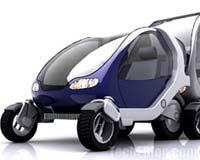
Robot-driven cars on roads by 2030
San Francisco (AFP) Feb 17, 2007 Scientists are developing the next generation of robot-driven cars and predict they could be shuttling humans around by the year 2030, a conference was told here Saturday. The first wave of intelligent robot cars, capable of understanding and reacting to the world around them, will be tested this November in a competition run by the US Defense Advanced Research Projects Agency (DARPA). Scientists are developing vehicles which will not only be driven by robots independently, but will be able to operate in a simulated city environment. "In the past it was sufficient for a vehicle just to perceive the environment, said Sebastian Thrun, an associate professor of computer science and electrical engineering at Stanford University. "The new challenge will be to understand the environment. The robot must be able to recognize another car, to understand that it is moving and that it will interact with it as it gets closer." Thrun, who was speaking at the American Association for the Advancement of Science annual meeting in San Francisco, is a member of the Stanford team participating in the DARPA competition, which will take place on November 3. Stanford's entrant "Junior" is a converted 2006 Volkswagen Passat whose steering, throttle and brakes all have been modified by engineers to be completely computer-controllable. An array of lasers fitted on the car bumpers, radar and global positioning systems feed data into the on-board computer to determine its location and position. Thrun predicted that leaps in artificial intelligence would lead to driverless cars on the roads by 2030. "Today we can drive about 100 miles (160 kilometers) before human assistance is necessary, by 2010 I expect this to go 1,000 miles (1,160 kilometers), by 2020 up to a million miles (1.6 million kilometers)," he said. "By 2030 you'll be able to see them on the highway, with a driving reliability that will exceed humans by orders of magnitude. "We believe this technology will affect all of us. It is going to have enormous significance for people who can't drive because of disabilities or because they are ill or impaired." Thrun said he believed robot-driven vehicles would be deployed in war zones before they are seen in everyday civilian environments. "I think they'll be on the battlefield by around 2015," he said. "It is going to make sense to use them in situations such as convoys, or in hostile environments where there is danger to personnel."
Source: Agence France-Presse Community Email This Article Comment On This Article Related Links Car Technology at SpaceMart.com Car Technology at SpaceMart.com
 Posh Areas Cough Up As London Expands Traffic Toll Zone
 London (AFP) Feb 18, 2007
A controversial charge on cars that enter the centre of the British capital is to be extended Monday to some of London's plushest districts -- threatening a new wave of anger. The brainchild of Mayor Ken Livingstone, the so-called congestion charge was greeted with howls of protest when it was imposed in February 2003 in a 20 square kilometre (7.7 square mile) zone of central London. |
|
|

| The content herein, unless otherwise known to be public domain, are Copyright 1995-2006 - SpaceDaily.AFP and UPI Wire Stories are copyright Agence France-Presse and United Press International. ESA PortalReports are copyright European Space Agency. All NASA sourced material is public domain. Additionalcopyrights may apply in whole or part to other bona fide parties. Advertising does not imply endorsement,agreement or approval of any opinions, statements or information provided by SpaceDaily on any Web page published or hosted by SpaceDaily. Privacy Statement |