|
 |
 |
 |
 |
 |
 |
 |
 |

 |
Robot Tracks Rocket In Space
Washington (UPI) Jun 01, 2004 For the first time ever, an airborne robotic sensor system developed by NASA has tracked a rocket during launch and communicated with its computer without human intervention. The test is considered a breakthrough in a launch technology that might one day lead to aircraft or orbiting satellites controlling space launches. Such a step might trim the cost of launching rockets by reducing the need for cumbersome, ground-based facilities to track and monitor vehicles as they ascend toward space. The prototype of the future system, called a Range Systems Transformational Laboratory, or RSTL, flew aboard a small research plane hovering 16,000 feet above the southern coast of California and 85 miles downrange from the ascending rocket. For the test, NASA used its launch of the Gravity Probe B on April 20 from Vandenberg Air Force Base. The satellite payload rode atop a Boeing Delta II space booster. While a lone pilot flew the plane, the robotic sensor system onboard searched for, detected, tracked and "interrogated" the booster and its payload as it rose and sped away from the launching base. The robot tracker kept its sensors aimed at the booster as it flew out over the Pacific Ocean to the horizon, out of the range of the 35-foot dishes arrayed along the coastline, and others carried by the ships and planes that normally are deployed during a launch. Conducting civil, military or commercial space launches from the range at Vandenberg, or at Cape Canaveral, Fla., requires expensive, ground-based equipment for tracking and control of the rockets. Maintaining the equipment costs NASA and the Air Force millions of dollars each year. "This is the beginning of the transformation toward truly mobile launch ranges," Ken Griesi, RSTL program manager for Lockheed Martin, told United Press International. The company's RSTL consists of S-band radar and other sensors transmitting to the rising rocket using a tiny, 2-foot dish aboard the plane and a sensor package called a RIP or Range Instrumentation Payload. Griesi explained planners of future space launch bases -- including long-range modernization plans for Vandenberg and Cape Canaveral -- hope to move some of the tracking, command and destruct functions now based on the ground to satellites in orbit. They also are planning to use global-positioning-system satellites to track future versions of today's Delta and Atlas launch vehicles. The idea would be to automate control over rockets in flight and cut the costs of such operations. Once such systems begin operation, they would, in theory, be more flexible and cheaper than continued use of existing fixed-range equipment. "What we wanted to do was take an incremental step toward that ulti mate objective," Griesi said. During the April test, computers aboard the RSTL did all the work without the need for interaction with a technician, the plane's pilot or ground control. As the robot's sensors swept across the hull of the speeding booster, the rocket's own computers responded to the call, returning data on temperature, pressure, speed and other information on its condition. During conventional launches, ground-based forces, both at the launch site and along the flight path of rockets must perform this function. Griesi envisions a next stage in development where unmanned drones carrying a robot sensor system like the RSTL would replace at least some of the expensive ground equipment. Fleets of the drones would take to the skies as the final countdown proceeds and then hover or loiter in the upper atmosphere, dispersed along the rocket's planned path. The unmanned planes then would follow the trajectory from blastoff "all the way into orbit," Griesi predicted. Tom Drymon, Lockheed's chief designer for the RSTL and RIP systems, said the device actually received its first checkout without leaving the ground. In September 2003 the system was placed on the ground and aimed at a military space booster being prepped for launch at Vandenberg. The RSTL was activated as a military Titan IV rocket lifted off. The RIP swept the Titan with its sensors and successfully established communications between the Titan and the unit. The speeding booster, several times larger than the Delta II, which was the focus of the April 20 test, sent back telemetry on its condition until it passed over the horizon. The result of the exchange gave developers confidence to attempt to carry the system aboard the research plane, which Drymon said can fly with or without a pilot. Flying it unmanned so close to a rocket base would have required many additional levels of ran ge safety clearance, so the decision was made to fly with a lone pilot aboard. "The pilot had no interaction with the RSTL," Drymon said. It took Lockheed officials almost a month to review and evaluate the data from the April 20 test. According to Griesi and Drymon, the results validated the whole concept. Funded through a joint project between the California Space Authority and the Air Force, the total cost of developing the RSTL prototype and conducting the twin rocket tests was $4 million. "We are having discussions with the Air Force, as well as the California Space Authority to look for additional missions and additional enhancements to the payload package (RSTL and RIP) to add additional elements," Griesi said. Those elements, he added, include, "extreme resolution video and commanding capability, and infrared tracking capability," although additional funds have not yet been made available for these improvements. Drymon -- who holds the patent for the RSTL -- sees future drones flying high up in the fringes of the atmosphere "at 70,000 feet," where the robotic tracker could see "wide parts of the Earth" as it tracked and, if needed, commanded flight changes to the rockets. "These would be platforms for sensor packages, extending the range beyond the confines of what's available today at the various ranges," Drymon said. Once such a system becomes operational in the United States, Drymon predicted, it also could be used around the world to increase access to space by lower costs of conducting launches. All rights reserved. Copyright 2004 by United Press International. Sections of the information displayed on this page (dispatches, photographs, logos) are protected by intellectual property rights owned by United Press International. As a consequence, you may not copy, reproduce, modify, transmit, publish, display or in any way commercially exploit any of the content of this section without the prior written consent of by United Press International. Community Email This Article Comment On This Article Related Links SpaceDaily Search SpaceDaily Subscribe To SpaceDaily Express All about the robots on Earth and beyond!
 Engineers Deliver Robot to Neutralize Remote Explosives
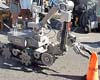 Tyndall AFB (SPX) Jun 30, 2005
Engineers from the Air Force Research Laboratory Materials and Manufacturing Directorate have rapidly prototyped, developed, and delivered low-cost expendable robots to disable and dispose of improvised explosive devices. |
|
|

| The content herein, unless otherwise known to be public domain, are Copyright 1995-2006 - SpaceDaily.AFP and UPI Wire Stories are copyright Agence France-Presse and United Press International. ESA PortalReports are copyright European Space Agency. All NASA sourced material is public domain. Additionalcopyrights may apply in whole or part to other bona fide parties. Advertising does not imply endorsement,agreement or approval of any opinions, statements or information provided by SpaceDaily on any Web page published or hosted by SpaceDaily. Privacy Statement |