|
 |
 |
 |
 |
 |
 |
 |
 |

 |
Robot Alone Via Antarctica
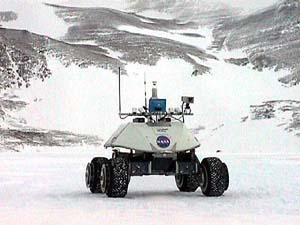
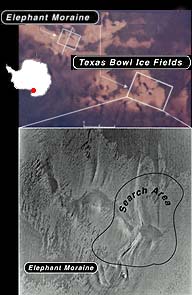
Pittsburgh - January 17, 2000 Researchers from Carnegie Mellon University's Robotics Institute have deployed a four-wheeled robot named Nomad to a site in Antarctica, where it will autonomously search for meteorites and classify them in the field with scientific instruments contained in a newly developed manipulator arm. The expedition marks the first time a robot will be used to discover extraterrestrial material that has fallen to Earth and could serve as a prototype for future scientific missions to Mars and the Moon. The Nomad research program and the expedition are funded by grants from the Cross Enterprise Technology Development Program of NASA's Office of Space Science. Additional support for a related public outreach program comes from the Heinz Endowments, the Henry C. Frick Fund of the Buhl Foundation and the Grable Foundation, all in Pittsburgh. The expedition is the result of a collaboration between Carnegie Mellon researchers and the National Science Foundation's (NSF) Antarctic Search for Meteorites (ANSMET) program, which funds the work of ANSMET scientists through its Office of Polar Programs. Since ANSMET was established in 1976, its members have collected more than 10,000 meteorites during their annual expeditions to Antarctica. They subsequently have been made available to the world's scientists for study. The principal investigator on the Nomad project is William L. "Red" Whittaker, the Fredkin research professor and founder of the Field Robotics Center at Carnegie Mellon's Robotics Institute. The project manager is Robotics Institute Systems Scientist Dimitrios Apostolopoulos. A six-member Carnegie Mellon team will be supporting the experiments on the ice. The group includes Robotics Institute doctoral students Stuart Moorhead, Liam Pedersen and Kim Shillcutt, Mark Sibenac and Michael Wagner, who are studying for master's degrees in electrical and computer engineering, and Ben Shamah, a senior research engineer at the Robotics Institute. The head of the ANSMET program is Ralph P. Harvey, assistant professor of geological science at Case Western Reserve University. His associate, John Schutt, will be collecting Nomad's meteorite choices in the field. "This expedition will showcase the ability of a robot to discover meteorites, distinguish them from surrounding rocks and do it in an autonomous, self-reliant, self-contained manner," said Whittaker. "The breakthrough technologies are robotic classification and search. Humans classify every time they sort pennies from nickels, and they search every time they lose their car keys.
"But these are new skills for robots. Classification and search both must succeed for the autonomous meteorite discovery to succeed. Until now, explorative robots have taken pictures, gathered data and returned what they viewed to scientists who made judgments and decisions. This time Nomad will make its own judgments and inferences about the rocks that it encounters," added Whittaker
ROBOT'S DO ANTARCTICA - PART TWO
Email This Article Comment On This Article Related Links Space
 Satellite Launch To Boost DTH In India
 Calcutta, India (SPX) Dec 28, 2005
The successful launch Thursday of India's heaviest satellite from spaceport of Kourou in French Guyana may have boosted the country's space research efforts to yet another level, but it has also lifted the spirits of at least three Direct-To-Home televisions broadcasters, one of which has been waiting for years to launch its services in India. |
|
|

|
|
|
|
|
|
|
|
|
|
|
|
| The content herein, unless otherwise known to be public domain, are Copyright 1995-2006 - SpaceDaily.AFP and UPI Wire Stories are copyright Agence France-Presse and United Press International. ESA PortalReports are copyright European Space Agency. All NASA sourced material is public domain. Additionalcopyrights may apply in whole or part to other bona fide parties. Advertising does not imply endorsement,agreement or approval of any opinions, statements or information provided by SpaceDaily on any Web page published or hosted by SpaceDaily. Privacy Statement |