|
 |
 |
 |
 |
 |
 |
 |
 |

 |
River Carbon Impacts On The Arctic Ocean
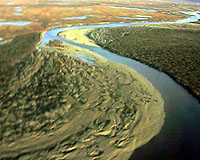
Woods Hole MA (SPX) Feb 14, 2008 Arctic rivers transport huge quantities of dissolved organic carbon (DOC) to the Arctic Ocean. The prevailing paradigm regarding DOC in arctic rivers is that it is largely refractory, making it of little significance for the biogeochemistry of the Arctic Ocean. However, a recent study by R. M. Holmes of the Woods Hole Research Center and colleagues at collaborating institutions challenges that assumption by showing that DOC in Alaskan arctic rivers is remarkably labile during the spring flood period when the majority of annual DOC flux occurs. The research was published February 9 in Geophysical Research Letters. According to Dr. Holmes, "Though only about 1% of global ocean volume, the Arctic Ocean receives almost 10% of global river discharge. As a consequence, organic carbon transported by arctic rivers has the potential to strongly impact the chemistry and biology of the Arctic Ocean". The primary focus of the paper is the lability of dissolved organic carbon in Alaskan arctic rivers, or how available the DOC is for microbial decomposition. Because of logistical challenges, past studies have focused almost exclusively on the summer low-flow period, when numerous studies have shown arctic river DOC to be refractory. However, by timing their sampling to include the high-flow period just after the spring ice break, the authors found that much of the DOC discharged by Alaskan rivers to the Arctic Ocean is labile. Consequently, riverine inputs of DOC to the Arctic Ocean may have a much larger influence on coastal ocean biogeochemistry than previously realized, and reconsideration of the role of terrigenous DOC on carbon, microbial, and food-web dynamics on the arctic shelf is warranted. Holmes says, "Though tantalizing evidence has been emerging in recent years, this study was the first to directly show that dissolved organic carbon in rivers during the spring flood period is highly labile." Rivers sampled for this project were the Kuparuk, Sagavanirktok, and Colville rivers on the North Slope of Alaska. The next step will be to conduct similar experiments on larger arctic rivers, including the massive rivers entering the Arctic Ocean from Siberia. Holmes adds, "If the pattern we've shown for Alaskan arctic rivers holds for the much larger Siberian rivers, and preliminary evidence suggests that it will, then we'll have to rethink the role of terrestrially-derived DOC as a potential energy source driving the coastal ocean foodweb in the Arctic." Community Email This Article Comment On This Article Related Links Woods Hole Research Center Water News - Science, Technology and Politics
 Water Planners Call For Fundamental Shift To Deal With Changing Climate
 Saettle WA (SPX) Feb 11, 2008
The past is no longer a reliable base on which to plan the future of water management. So says a new perspectives piece written by a prominent group of hydrologists and climatologists, published in Science magazine, that calls for fundamental changes to the science behind water planning and policy. |
|
|

| The content herein, unless otherwise known to be public domain, are Copyright 1995-2007 - SpaceDaily.AFP and UPI Wire Stories are copyright Agence France-Presse and United Press International. ESA Portal Reports are copyright European Space Agency. All NASA sourced material is public domain. Additional copyrights may apply in whole or part to other bona fide parties. Advertising does not imply endorsement,agreement or approval of any opinions, statements or information provided by SpaceDaily on any Web page published or hosted by SpaceDaily. Privacy Statement |