|
 |
 |
 |
 |
 |
 |
 |
 |

 |
Risk From 2029 Asteroid Now More Remote
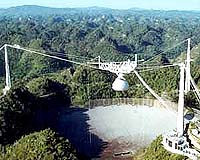
Cambridge, England (AFP) Sep 05 2005 An asteroid that triggered a scare last December after astronomers calculated that it ran a potential risk of smacking into Earth is less of a peril than thought, an expert said here Monday. The rogue rock, 2004 MN4, measures 320 metres (1,000 feet) across, making it big enough to wipe out a large city if it ever collided with Earth. Last December, there were a few nail-biting days when NASA calculated, from early optical observations, that the asteroid had a more than one-in-50 chance of hitting Earth on April 13, 2029. In addition, astronomers could not rule out a risk that the rock could in fact hit Earth, its trajectory tweaked by terrestial gravity, when it made another swing around the Sun, this time in 2036. But measurements using Doppler radar at the giant Arecibo telescope in Puerto Rico have progressively fine-tuned the risk, which appears to be receding, said Jon Giorgina of NASA's Jet Propulsion Laboratory (JPL). These calculations show that the previous estimate of the flyby, of a distance of 36,000 kilometers (22,500 miles) from Earth's surface, may be out by some 4,000 kms (2,500 miles), Giorgina told AFP. In 2029, the asteroid will in fact swing by at around 32,000 kilometers (20,000 miles), making it an even narrower shave. The rock -- now renamed 99942 Apophis -- will make one of the narrowest flybys of Earth of any dangerous space object. It will be inside the orbits of some geostationary satellites and be visible to the naked eye. But the closer flyby has a big impact on celestial mechanics, which means that, come 2036, Earth and asteroid will be much farther apart -- by up to 14 million kms (8.75 million miles), according to Giorgina's arithmetic. Giorgina said the probability crunching would continue. More data will come from further radar measurements next May and also in 2013, when Apophis will come close to Earth. "What you learn is that it's worthwhile getting as many measurements as possible," he said. The risk from Apophis had prompted a call from former Apollo astronaut Rusty Schweickart for a mission to attach a radio transponder to it in 2013. The transponder would send out precision signals, giving the asteroid's exact location and thus enabling Earth to prepare a mission to deflect it or even destroy it in the future, if need be. Collisions by big comets or asteroids are extremely remote, but any such event would carry enormous costs. The long reign of the dinosaurs is believed to have been extinguished some 65 million years ago when a comet or large asteroid smashed into modern-day Mexico, kicking up a pall of dust that obscured the Sun, chilled the climate and destroyed vegetation. Smaller objects measuring two or three hundred metres (yards) across could devastate a region or unleash a tsunami if they plunged into the ocean. Giorgina presented his team's research at a meeting in Cambridge of the American Astronomical Society (AAS) and Royal Astronomical Society (RAS). CommunityEmail This Article Comment On This Article Related Links SpaceDaily Search SpaceDaily Subscribe To SpaceDaily Express Asteroid and Comet Mission News, Science and Technology
 NASA'S Spitzer Finds Possible Comet Dust Around Dead Star
 Pasadena CA (SPX) Jan 12, 2006
NASA's Spitzer Space Telescope has spotted what may be comet dust sprinkled around the white dwarf star G29-38, which died approximately 500 million years ago. |
|
|

| The content herein, unless otherwise known to be public domain, are Copyright 1995-2006 - SpaceDaily.AFP and UPI Wire Stories are copyright Agence France-Presse and United Press International. ESA PortalReports are copyright European Space Agency. All NASA sourced material is public domain. Additionalcopyrights may apply in whole or part to other bona fide parties. Advertising does not imply endorsement,agreement or approval of any opinions, statements or information provided by SpaceDaily on any Web page published or hosted by SpaceDaily. Privacy Statement |