|
 |
 |
 |
 |
 |
 |
 |
 |

 |
Rising Prospect Of Japan Remilitarization
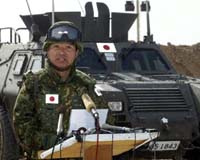
Tokyo (UPI) - Mar 05, 2004 From giant department stores to main airports, there were little signs of public security jitters in this Tokyo metropolitan city with a population of more than 12 million. Reflecting a fledgling recovery of the local economy, shopping malls in Shibuya central Tokyo were packed with consumers. Not far away, however, the U.S. Embassy is heavily guarded by a number of police armed with batons and guns. A police official said the security measure is to prevent any possible terror attacks. The U.S. Embassy is one of 650 "vital" facilities across Japan designated by the National Police Agency to be put under increased surveillance since late last month. They include nuclear power plants, Narita and Haneda airports, government offices and U.S.-related facilities. Police said the high security alert was to guard against possible terror Attacks as Japan sends its troops to help in U.S.-led efforts to rebuild Iraq. But the police agency declined to say whether there had been any information concerning a possible attack. A Tokyo metropolitan government official cited the explosions near the Defense Ministry in Tokyo last month as the reason for tougher security measures. There were two late-night explosions near the ministry building on Feb. 17. No damage or injuries were reported. In letters to Japanese media, a leftist group calling itself "Kakumeigun," or Revolutionary Army, claimed responsibility for the explosions. The group said it was resorting to violence to protest the deployment of Japanese troops to Iraq, according to Japanese news reports. But the heightened security alert seems part of Japan's long-standing efforts to rebuild the country into a "normal state" with a formal national army. Under its war-renouncing constitution, Japan is not aLlowed to have national army to use of force in settling international disputes. Instead, Japan has heavily depended on the United States for its defense since the end of World War II. In the changing global situation, Prime Minister Junichiro Koizumi is facing growing demand for Japan to step out of the shadow of the United States and develop its own national security policy in order to promote its international role, commensurate with its economic capabilities. As Tokyo is sending troops to help the U.S.-led coalition reconstruct Iraq, its pacifist constitution undergoes a review to make it possible for Japan to exercise the internationally recognized right of collective defense. Japan has begun to dispatch some 1,000 non-combat military personnel to southern Iraq to repair the war-shattered infrastructure. It would be Japan's first dispatch of its Self-Defense Forces to a country where fighting is taking place sinceThe SDF were inaugurated in 1954, following World War II. Analysts say the revision of Japan's pacifist constitution is just a matter of time because parliamentary forces that wanted to keep the constitution unchanged suffered severe setbacks in November's lower house general election. The Japanese Communist Party, which had been major parliamentary force calling to preserve the pacifist nature of the constitution, won just nine seats, down from 20 it held before the Nov. 9 House of Representatives election. The Social Democratic Party, which has also defended the constitution's pacifist character, fell from 18 to six. With their combined 15 seats in the 480-seat House of Representatives, the two parties can hardly defend the constitution. Koizumi's Liberal Democratic Party has already pledged to amend the constitution and plans to come up with a draft revision by 2005, marking the party's 50th anniversary. For its pArt, the New Conservative Party has also vowed to draw up proposals to revise the constitution by the end of this year. New Komeito supports the constitution revision, while the Democratic Party of Japan has called for creating a new constitution altogether. Upbeat about the favorable conditions, Koizumi has made clear that he would legitimize the Self-Defense Forces by revising the controversial pacifist constitution. Japan is apparently using its troop dispatch to Iraq as a critical occasion to legitimize the SDF and revise the constitution. This week, Tokyo Mayor Shintaro Ishihara, a devoted chauvinist, told the Financial Times that if Japanese ground troops dispatched to Iraq are killed or injured, public opinion will call for the earlier revision of the constitution. "The troop dispatch signals the first step for Japan to recognize and realize its sovereignty over military affairs as a normal state," said TerumasaNakanishi, a professor at Kyoto University. A security threat from neighboring communist North Korea offers another opportunity for Japan to seek remilitarization. The overflights of Japan by North Korean missile tests in 1998 has triggered a resurgence of military preparedness, a development being monitored with growing concern in North and South Korea and China. Japan is also worried about how to deal with North Korea's nuclear weapons drive. "The prospect of North Korea's nuclear capability is of vital concern to Japan," said Yoon Duk-min, a researcher at the Seoul-based Institute for Foreign Affairs and National Security. "But Japan lacks the ability to develop an independent policy to cope with the threat." Yoon and other analysts in Seoul say North Korea's threats raise prospect of Japanese remilitarization. According to a survey by Tokyo's Asahi Shimbun newspaper last week, some 50 percent of Japanese support eConomic sanctions on North Korea. Some 38 percent opted for dialogue with Pyongyang to end its nuclear ambition. Backed by toughening public opinion, LDP Secretary General Shinzo Abe said Japan was ready to impose economic sanctions on North Korea if the reclusive country did not properly address the issues of nuclear weapons and the abduction of Japanese citizens. "Without North Korea, how Japan can strongly push for a constitutional amendment to legalize the SDF?" Asked Naoki Murayama, a 32-year-old resident in Ebis, Tokyo. All rights reserved. Copyright 2004 by United Press International. Sections of the information displayed on this page (dispatches, photographs, logos) are protected by intellectual property rights owned by United Press International. As a consequence, you may not copy, reproduce, modify, transmit, publish, display or in any way commercially exploit any of the content of this section without the prior written consent of by United Press International. Community Email This Article Comment On This Article Related Links SpaceDaily Search SpaceDaily Subscribe To SpaceDaily Express Military Space News at SpaceWar.com
 Space Group To Activate New Unit
 Colorado Springs CO (SPX) Jan 6, 2006
Air Force Reserve Command's 310th Space Group will travel deeper into the space program when it activates a new unit Jan. 7. Headquarters Reserve National Security Space Institute will be a Reserve associate unit to the National Security Space Institute in Colorado Springs, Colo. The institute is the Department of Defense's focal point for providing education about space power in joint warfighting. |
|
|

| The content herein, unless otherwise known to be public domain, are Copyright 1995-2006 - SpaceDaily.AFP and UPI Wire Stories are copyright Agence France-Presse and United Press International. ESA PortalReports are copyright European Space Agency. All NASA sourced material is public domain. Additionalcopyrights may apply in whole or part to other bona fide parties. Advertising does not imply endorsement,agreement or approval of any opinions, statements or information provided by SpaceDaily on any Web page published or hosted by SpaceDaily. Privacy Statement |