|
 |
 |
 |
 |
 |
 |
 |
 |

 |
Riders On The Storm
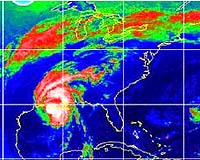
Arlington VA (SPX) Nov 19, 2004 While some are still cleaning up from the series of hurricanes that plowed through the Caribbean and southern United States this season, scientists supported by the Office of Naval Research are busily cleaning up valuable data collected during the storms. As part of a project called CBLAST, for Coupled Boundary Layer/Air-Sea Transfer, researchers air-dropped specially designed instruments into the paths of the hurricanes - and into the hurricanes themselves. The rapid-fire hurricanes barely gave researchers time to rest between flights that took them into the hearts of Hurricanes Frances, Ivan, and Jeanne. "This season has seen a breakthrough in hurricane and oceanographic research," said ONR program manager Dr. Carl Friehe. "Real-time data sent back by the drifters and floats have created great interest among oceanographers, meteorologists, and hurricane forecasters." Project CBLAST-Hurricane focuses on the energy exchanges between the ocean and atmosphere during a hurricane, and how those interactions affect a storm's intensity (a separate CBLAST component studies low-wind interactions). By better understanding these energy exchanges, scientists can develop better models to predict a hurricane's development. A hurricane's intensity determines the size of the storm surge of water that precedes it - which can pose a significant threat to ships in port. New instruments that can measure the ocean water's temperature, salt content, and velocity -before, during, and after a hurricane - are providing a unique view of the conditions that affect a storm's intensity. While satellites can provide ocean temperature data, they only monitor the "skin" or surface of the ocean down to just 1/8th of an inch. To reach into lower depths, ONR has sponsored the development of new ocean probes by Dr. Eric D'Asaro and Dr. Tom Sanford of the University of Washington Applied Physics Laboratory (Seattle), and Dr. Peter Niiler and Dr. Eric Terrill of Scripps Institution of Oceanography (La Jolla, Ca). The data collected on water conditions over the course of a hurricane are crucial to forecast modeling because "the ocean is the gasoline for the hurricane's engine," explained ONR's Friehe. During the summer and fall, the sun warms the top hundred meters or so of the ocean. Hurricanes only form over these warm ocean regions, where water easily evaporates and is picked up by swirling weather patterns. "In order to build a model that can predict a storm's development, we need to know exactly how much energy is in the water, as well as how it is distributed by depth and location between Africa and the Caribbean," he said. The floats from the UW Applied Physics Lab and Scripps are programmed to bob up and down through the upper 200 meters (656 ft) of the ocean, measuring the water's temperature, salinity, dissolved gases, and velocity. They also monitor underwater sounds as part of a study to develop methods of measuring hurricane force winds and rainfall. The floats from the Applied Physics Lab are deployed in a line perpendicular to a hurricane's path, so that one is centered on the eye, another is about 50 km (27 nautical miles) to the north of the eye, and a third 100 km (54 nm) to the north. Each time the instruments reach the water's surface, they transmit data back to scientists using satellite communications. Drifters from the Scripps team remain on the ocean's surface, floating like bottles with a message that's constantly updated as their instruments measure air pressure, wind speed and direction, and sea surface temperature. They can collect data for as long as their batteries continue to function (up to several months) or they can be picked up by passing ships for reuse and downloading of more detailed information than they are able to transmit. The drifters and floats were dropped into the paths of this season's hurricanes by the U.S. Air Force Reserve 53rd Weather Reconnaissance Squadron (Keesler AFB, Miss.) from two C130J Hercules aircraft. The probes parachuted into the ocean and automatically began taking measurements. They returned time series of ocean profiles that documented the upwelling and mixing caused by the hurricanes. Several of the floats and drift buoys obtained an unprecedented second set of hurricane observations as Hurricane Jeanne followed closely on the path of Frances. While the drifters and floats weathered the storms from sea level and below, other CBLAST instruments - and researchers - flew through Hurricane Jeanne in two National Oceanic and Atmospheric Administration (NOAA) WP-3D aircraft. From various altitudes throughout the storms, and with the help of fixed and deployed instruments, they collected data on air temperature and pressure, wind speed and direction, and precipitation. The combination of atmospheric and ocean science, technology (GPS, cell phones, miniature computers, etc.), deployment via aircraft, and the need for better hurricane forecasting have all come together in 2004 to mark a sea change in hurricane research, according to Friehe. NOAA provides project management for CBLAST, as well as researchers, aircraft, flight crews, and other support through its Hurricane Research Division, Aircraft Operations Center, and Office of Oceanic and Atmospheric Research. Researchers from the University of Miami, Rosenstiel School; University of Washington Applied Physics Lab; Scripps Institution of Oceanography; Massachusetts Institute of Technology; and the University of Massachusetts Microwave Remote Sensing Laboratory also participated. The 5-year (FY01-FY05) funding amount for CBLAST Hurricane is: $5.3 M from ONR and $0.7 M from NOAA's U.S. Weather Research Program (USWRP). Community Email This Article Comment On This Article Related Links CBLAST SpaceDaily Search SpaceDaily Subscribe To SpaceDaily Express Earth Observation News - Suppiliers, Technology and Application
 Weatherman's Monsoon Talk Says It All In Agriculture-Dependent India
 Bangalore, India (AFP) Jun 05, 2005
Prashant Goswami at this time of year has farmers, government officials, global investors, stock market players and economists hanging on his every word -- provided he's making monsoon talk. |
|
|

| The content herein, unless otherwise known to be public domain, are Copyright 1995-2006 - SpaceDaily.AFP and UPI Wire Stories are copyright Agence France-Presse and United Press International. ESA PortalReports are copyright European Space Agency. All NASA sourced material is public domain. Additionalcopyrights may apply in whole or part to other bona fide parties. Advertising does not imply endorsement,agreement or approval of any opinions, statements or information provided by SpaceDaily on any Web page published or hosted by SpaceDaily. Privacy Statement |