|
 |
 |
 |
 |
 |
 |
 |
 |

 |
Rice Finds On-Off Switch For Buckyball Toxicity
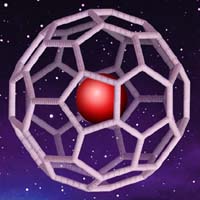
Houston TX (SPX) Sep 27, 2004 Researchers at Rice University's Center for Biological and Environmental Nanotechnology (CBEN) have demonstrated a simple way to reduce the toxicity of water-soluble buckyballs by a factor of more than ten million. The research will appear in an upcoming issue of the journal Nano Letters, published by the American Chemical Society, the world's largest scientific society. One of the first toxicological studies of buckyballs, the research was published online by the journal on Sept. 11. Buckyballs, whose chemical notation is C60, are hollow, soccerball-shaped molecules containing 60 carbon atoms. Their diameter is just one-billionth of a meter, or one nanometer, and their discovery at Rice in 1985 is widely regarded as an early milestone in the field of nanotechnology. While buckyballs show great promise in applications as diverse as fuel cells, batteries, pharmaceuticals and coatings, some scientists and activists have raised concerns about their potential toxicity to humans and animals. CBEN's study is the first cytotoxicity study of human cells exposed to buckyballs. Cytotoxicity refers to toxic effects on individual cells. The study found that even minor alterations to the surface of the buckyballs can dramatically affect how toxic they are to individual cells, and the researchers identified specific alterations that render them much less toxic. "There are many cases where toxicity is desirable," said Vicki Colvin, CBEN director, professor of chemistry and chemical engineering, and the principal investigator for the research. "For example, we might want particles that kill cancer cells or harmful bacteria. In other cases - like applications where particles may make their way into the environment - toxicity is undesirable." In the study, the researchers exposed two types of human cells to various solutions containing different concentrations of buckyballs. Four types of solutions were tested. One contained tiny clusters of smooth-surfaced buckyballs. In the other three, researcher s modified the buckyballs by attaching other molecules to their sides. Researchers measured how many cells died within 48 hours of exposure to each solution, and they repeated the tests until they found the exposure level for each that resulted in a 50 percent mortality rate. In general, the greater the degree of surface modification, the lower the toxicity. For example, the undecorated buckyballs showed the highest toxicity - about 20 parts per billion- while the least toxic proved to be buckyballs decorated with the largest number of hydroxyl side-groups. To achieve the equivalent level of toxicity as that of bare buckyballs, the researchers had to increase the concentration of these modified buckyballs by 10 million times to more than 5 million parts per billion. "We're encouraged to see that controlling the surface properties of buckyballs allows us to dial the level of toxicity up or down, because making those kinds of modifications is something that chemists do every day in university research labs and in industry," Colvin said. "Moreover, we believe the technique can prove useful in tuning the toxicity of other nanoparticles." The researchers postulate that cell death in the tests occurred via physical disruption of the cell membrane by oxygen radical species generated by the buckyballs. Colvin and her colleagues emphasize that the study only fills in part of the puzzle regarding fullerene toxicity. For example, because cytotoxic studies look only at cells in culture, they don't tell scientists what happens inside the body, where cellular repair mechanisms, whole-organ and whole-body processes come into play. "Cytotoxicity should not be confused with a full-fledged toxicological risk assessment," said Kevin Ausman, CBEN executive director and a co-author of the paper. "Risk assessments take into account exposure rates, uptake mechanisms, transport within the body and much more. Most often, cytotoxicity studies are used as indicators of whether more extensive toxicological study is needed. Based on our results we think buckyballs should be studied in more detail, and we're already working to arrange additional studies." Community Email This Article Comment On This Article Related Links Rice University SpaceDaily Search SpaceDaily Subscribe To SpaceDaily Express Nano Technology News From SpaceMart.com Computer Chip Architecture, Technology and Manufacture
 Water, Water Everywhere Nano
 New York (UPI) Mar 18, 2005
One of the single biggest applications of nanotechnology could be solving the global shortage of pure water, experts told UPI's Nano World. |
|
|

| The content herein, unless otherwise known to be public domain, are Copyright 1995-2006 - SpaceDaily.AFP and UPI Wire Stories are copyright Agence France-Presse and United Press International. ESA PortalReports are copyright European Space Agency. All NASA sourced material is public domain. Additionalcopyrights may apply in whole or part to other bona fide parties. Advertising does not imply endorsement,agreement or approval of any opinions, statements or information provided by SpaceDaily on any Web page published or hosted by SpaceDaily. Privacy Statement |