|
 |
 |
 |
 |
 |
 |
 |
 |

 |
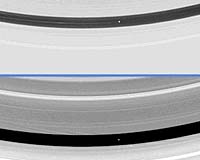
Revealing Pan's Influence
Pasadena CA (JPL) Jun 28, 2005 Saturn's moon Pan is seen here orbiting within the Encke Gap in Saturn's A ring in two differently processed versions of the same Cassini image. The little moon is responsible for clearing and maintaining this gap, named for Johann Franz Encke, who discovered it in 1837. Pan is 20 kilometers (12 miles) across. The top image reveals two of the faint, dusty ringlets that occupy the gap along with Pan. One of the ringlets occupies nearly the same orbit as Pan, while the other is closer to the gap's inner edge. Not only do the ringlets vary in brightness, but they also appear to move in and out along their length, resulting in notable "kinks," which are similar in appearance to those observed in the F ring (see PIA06585). One possible explanation for the complex structure of the ringlets is that Pan may not be the only moonlet in this gap. Pan is responsible for creating stripes, called 'wakes,' in the ring material on either side of it. Since ring particles closer to Saturn than Pan move faster in their orbits, these particles pass the moon and receive a gravitational "kick" from Pan as they do. This kick causes waves to develop in the gap where the particles have recently interacted with Pan (see PIA06099), and also throughout the ring, extending hundreds of kilometers into the rings. These waves intersect downstream to create the wakes, places where ring material has bunched up in an orderly manner thanks to Pan's gravitational kick. In the bottom image, the bright stripes or wakes moving diagonally away from the gap's edges can be easily seen. The particles near the inner gap edge have most recently interacted with Pan and have just passed the moon. Because of this, the disturbances caused by Pan on the inner gap edge are ahead of the moon. The reverse is true at the outer edge: the particles have just been overtaken by Pan, leaving the wakes behind it. This image was taken in visible light with the Cassini spacecraft narrow-angle camera on May 18, 2005, at a distance of approximately 1.6 million kilometers (1 million miles) from Pan and at a Sun-Pan-spacecraft, or phase, angle of 44 degrees. The image scale is 9 kilometers (6 miles) per pixel. Community Email This Article Comment On This Article Related Links Cassini-Huygens at JPL Cassini Imaging Team SpaceDaily Search SpaceDaily Subscribe To SpaceDaily Express Explore The Ring World of Saturn and her moons Jupiter and its Moons The million outer planets of a star called Sol News Flash at Mercury
 Cassini Images Halo Around Titanic Moon Off Saturn
 Pasadena CA (SPX) Dec 27, 2005
With its thick, distended atmosphere, Titan's orange globe shines softly, encircled by a thin halo of purple light-scattering haze. |
|
|

| The content herein, unless otherwise known to be public domain, are Copyright 1995-2006 - SpaceDaily.AFP and UPI Wire Stories are copyright Agence France-Presse and United Press International. ESA PortalReports are copyright European Space Agency. All NASA sourced material is public domain. Additionalcopyrights may apply in whole or part to other bona fide parties. Advertising does not imply endorsement,agreement or approval of any opinions, statements or information provided by SpaceDaily on any Web page published or hosted by SpaceDaily. Privacy Statement |