|
 |
 |
 |
 |
 |
 |
 |
 |

 |
Retreating Glaciers Spur Alaskan Earthquakes
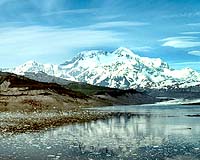
Greenbelt MD (SPX) Aug 03, 2004 In a new study, NASA and United States Geological Survey (USGS) scientists found that retreating glaciers in southern Alaska may be opening the way for future earthquakes. The study examined the likelihood of increased earthquake activity in southern Alaska as a result of rapidly melting glaciers. As glaciers melt they lighten the load on the Earth's crust. Tectonic plates, that are mobile pieces of the Earth's crust, can then move more freely. The study appears in the July issue of the Journal of Global and Planetary Change. Jeanne Sauber of NASA's Goddard Space Flight Center, Greenbelt, Md., and Bruce Molnia, a research geologist at USGS, Reston, Va., used NASA satellite and global positioning system receivers, as well as computer models, to study movements of Earth's plates and shrinking glaciers in the area. "Historically, when big ice masses started to retreat, the number of earthquakes increased," Sauber said. "More than 10,000 years ago, at the end of the great ice age, big earthquakes occurred in Scandinavia as the large glaciers began to melt. In Canada, many more moderate earthquakes occurred as ice sheets melted there," she added. Southern Alaskan glaciers are very sensitive to climate change, Sauber added. Many glaciers have shrunk or disappeared over the last 100 years. The trend, which appears to be accelerating, seems to be caused by higher temperatures and changes in precipitation. In southern Alaska, a tectonic plate under the Pacific Ocean is pushing into the coast, which creates very steep mountains. The high mountains and heavy precipitation are critical for glacier formation. The colliding plates create a great deal of pressure that builds up, and eventually is relieved by earthquakes. The weight of a large glacier on top of these active earthquake areas can help keep things stable. But, as the glaciers melt and their load on the plate lessens, there is a greater likelihood of an earthquake happening to relieve the large strain underneath. Even though shrinking glaciers make it easier for earthquakes to occur, the forcing together of tectonic plates is the main reason behind major earthquakes. The researchers believe that a 1979 earthquake in southern Alaska, called the St. Elias earthquake, was promoted by wasting glaciers in the area. The earthquake had a magnitude of 7.2 on the Richter scale. Along the fault zone, in the region of the St. Elias earthquake, pressure from the Pacific plate sliding under the continental plate had built up since 1899 when previous earthquakes occurred. Between 1899 and 1979, many glaciers near the fault zone thinned by hundreds of meters and some completely disappeared. Photographs of these glaciers, many taken by Molnia during the last 30 years, were used to identify details within areas of greatest ice loss. Field measurements were also used to determine how much the glacier's ice thickness changed since the late 19th century. The researchers estimated the volume of ice that melted and then calculated how much instability the loss of ice may have caused. They found the loss of ice would have been enough to stimulate the 1979 earthquake. Along with global positioning system measurements made by Sauber and Molnia a number of NASA satellites were used to document glacier variability. Data from Landsat-7 and the Shuttle Radar Topography Mission (SRTM) were used to study glacier extent and topography. Currently, NASA's ICESat satellite is being used to measure how the glacier thicknesses are changing. "In the future, in areas like Alaska where earthquakes occur and glaciers are changing, their relationship must be considered to better assess earthquake hazard, and our satellite assets are allowing us to do this by tracking the changes in extent and volume of the ice, and movement of the Earth," Sauber said. Community Email This Article Comment On This Article Related Links SpaceDaily Search SpaceDaily Subscribe To SpaceDaily Express Nuclear Space Technology at Space-Travel.com
 Rewriting Glacial History In Pacific North America
 Edmonton AB (SPX) Jan 10, 2006
Although the story on glacier fluctuations in northwestern North America over the last 10,000 years has remained largely unchanged for decades, new evidence discovered by a University of Alberta researcher will rewrite that glacial history and offer clues about our climate history during the last several thousand years. |
|
|

| The content herein, unless otherwise known to be public domain, are Copyright 1995-2006 - SpaceDaily.AFP and UPI Wire Stories are copyright Agence France-Presse and United Press International. ESA PortalReports are copyright European Space Agency. All NASA sourced material is public domain. Additionalcopyrights may apply in whole or part to other bona fide parties. Advertising does not imply endorsement,agreement or approval of any opinions, statements or information provided by SpaceDaily on any Web page published or hosted by SpaceDaily. Privacy Statement |