|
 |
 |
 |
 |
 |
 |
 |
 |

 |
Restraint and not pressure stops ICBM test: India
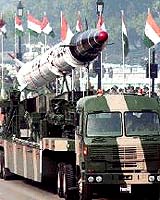
New Delhi (AFP) May 15, 2006 India on Monday said "self-imposed restraint" and not Western pressure prevented it from testing its longest-range ballistic missile capable of carrying a nuclear warhead. The assertion came a day after India's top military scientist M. Natarajan said he awaited the government's nod to flight-test the Agni-III (Fire) missile which has an official range of 4,000 kilometres (2,480 miles). "We have no pressure on us. Nor are we putting any political pressure," Defence Minister Pranab Mukherjee told a military function in New Delhi. "It is just we have decided to have self-imposed restraint because as responsible members of the international community, we want to keep our international commitments on non-proliferation," he told reporters. The Defence Research and Development Organisation (DRDO), which built the missile system, has put off tests of the solid-fuel Agni-III several times since November 2004. Mukherjee, however, said self restraint would not prevent India from carrying out other tests on the Agni-III, which many experts say has an inter-continental reach of almost 6,000 kilometres. "Self-restraint does not mean that DRDO can't go ahead with cold-bed tests for the sub-systems of the missile," Mukherjee said. The comments came as DRDO scientists said they could launch Agni-III in less than three weeks. "We are all ready to go and in two-three weeks we can assemble it and launch. In fact, we have a schedule for three tests including one with the end user," a missile scientist from the DRDO told AFP. Once ready, the two-stage missile, which can carry a one-tonne warhead, will be handed over to the army for deployment. India's arch-rival Pakistan on April 29 test fired a nuclear-capable missile with a range of 2,000 kilometres. India has already tested several variants of the Agni missiles with the ability to strike targets between 800 and 1,500 kilometres and has developed an arsenal of other surface and maritime missiles. Last October nuclear rivals India and Pakistan agreed to give advance notice of ballistic missile tests to avoid misunderstandings. The two countries carried out tit-for-tat nuclear explosions in 1998 and have declined to sign global nuclear arms treaties. India however agreed earlier this year to put 14 of its civilian atomic reactors under international safeguards in return for frontline nuclear technology from the United States. India in 1998 carried out a series of nuclear weapons tests and imposed an unilateral moratorium on testing after announcing possessing a minimum credible deterrence. Prime Minister Manmohan Singh on Sunday told DRDO scientists to develop smart weapons to battle terrorism. "We plan to go in for precision-guided munitions as well as unmanned vehicle technologies. "Such futuristic weapons systems are also needed to contend with trans-national actors and unconventional forces which are emerging as threats to the international order," he told the military function. Community Email This Article Comment On This Article Related Links Learn about missile defense at SpaceWar.com All about missiles at SpaceWar.com
 India's longest-range missile ready for test launch: official
 New Delhi, (AFP) May 14, 2006
 India's longest-range ballistic missile is ready for a test launch, the country's top military scientist announced Sunday. "We are technically ready for the test-firing of the missile," M. Natarajan, scientific advisor to the defence ministry, announced at an official function in New Delhi which was also attended by Prime Minister Manmohan Singh. |
|
|

| The content herein, unless otherwise known to be public domain, are Copyright 1995-2006 - SpaceDaily.AFP and UPI Wire Stories are copyright Agence France-Presse and United Press International. ESA PortalReports are copyright European Space Agency. All NASA sourced material is public domain. Additionalcopyrights may apply in whole or part to other bona fide parties. Advertising does not imply endorsement,agreement or approval of any opinions, statements or information provided by SpaceDaily on any Web page published or hosted by SpaceDaily. Privacy Statement |