
 |
 |
 |
 |
 |
 |
 |
 |
 |

 |
Researchers Uncover World's Oldest Fossil Impression Of A Flying Insect
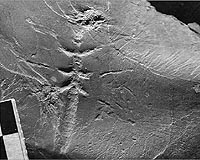
Somerville MA (SPX) Oct 22, 2008 While paleontologists may scour remote, exotic places in search of prehistoric specimens, Tufts researchers have found what they believe to be the world's oldest whole-body fossil impression of a flying insect in a wooded field behind a strip mall in North Attleboro, Mass. During a recent exploration as part of his senior project, Richard J. Knecht, a Tufts geology major, and Jake Benner, a paleontologist and senior lecturer in the Geology Department, set out to hunt for fossils at a location they learned of while reading a master's thesis that had been written in 1929. With chisels and hammers, the team reached the shale and sandstone outcropping described in the paper. There they delicately picked away pieces of rock before reaching a section that yielded fossils. Just below the surface, they uncovered a fossilized impression of a flying insect.
Not just any fossil Knecht says a preserved full-body impression of a flying insect from this or any previous period has never been discovered. The fossil, Benner says, "captures a moment in time over 300 million years ago when a flying insect just happened to land on a damp, muddy surface leaving almost a perfect impression of its body behind." Knecht and Benner presented the fossil at the Second International Congress on Ichnology, in Krakow, Poland last month. The pair will present other trace fossils from the site, including tracks of amphibians and precursors to reptiles, at the Annual Meeting of the Geological Society of America meeting in Houston later this month. Paleontologists use fossilized remains of insect bodies to study anatomy and develop hypotheses about evolutionary processes. Typically the only evidence available for this type of work is remains of insect wings. Bodies of primitive flying insects are rarely preserved and therefore little is known about them. The North Attleboro fossil will provide researchers with evidence of how it moved once it landed on a surface, as well as its stance, position of its legs and details about its abdomen and thorax. The impression is about three inches long and is imprinted on the flat side of a rock. The impression does not contain direct evidence of the insect having wings but Knecht and Benner say evidence suggests that it was a winged insect. According to Benner, the insect's anatomy and body plan are consistent with those of primitive flying insects. He also points out that "there are no walking tracks leading up to the body impression, indicating that it came from above." Michael S. Engel, a leading entomologist at the University of Kansas, is working with Knecht and Benner to study the insect. He says that a preliminary inspection of the anatomy indicates that it may be related to the common mayfly. "We can tell from the imprint that it has a very squat position when it lands," Engel says. "Its legs are sprawled and its belly is pressed down. The only group that does that today is the mayfly." Identifying the insect will also help the researchers to gain knowledge about the ecosystem of that period and what type of animals lived in it. The specimen may also advance understanding of insect flight and evolution from smaller, non-flying scurrying animals. "Once we pin down what type of insect it is we can begin to think about the conditions, the climate and life that must have existed in the environment to support its life," says Knecht. "One focus is the insect itself. Another is the broader big picture of the world it lived in."
A moment 300 million years ago Community Email This Article Comment On This Article Share This Article With Planet Earth
Related Links Tufts University Darwin Today At TerraDaily.com
 New Fossil Reveals Primates Lingered In Texas
 Austin TX (SPX) Oct 22, 2008
More than 40 million years ago, primates preferred Texas to northern climates that were significantly cooling, according to new fossil evidence discovered by Chris Kirk, physical anthropologist at The University of Texas at Austin. |
|
|

| The content herein, unless otherwise known to be public domain, are Copyright 1995-2007 - SpaceDaily.AFP and UPI Wire Stories are copyright Agence France-Presse and United Press International. ESA Portal Reports are copyright European Space Agency. All NASA sourced material is public domain. Additional copyrights may apply in whole or part to other bona fide parties. Advertising does not imply endorsement,agreement or approval of any opinions, statements or information provided by SpaceDaily on any Web page published or hosted by SpaceDaily. Privacy Statement |
 del.icio.us
 Digg
Digg Reddit
 YahooMyWeb
 Google
 Facebook