|
 |
 |
 |
 |
 |
 |
 |
 |

 |
Researchers Spin Carbon Nanotubes Into Usable Fibers
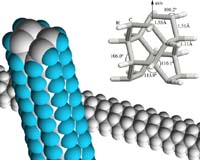
Philadelphia PA (SPX) Sep 03, 2004 Materials scientists from the University of Pennsylvania and chemists from Rice University report the first large-scale manufacture of fibers composed solely of single-walled carbon nanotubes (SWNTs) in the Sept. 3 issue of the journal Science. This new material is a macroscopic realization of many of the amazing mechanical, electrical and thermal properties of nano-scale ideal nanotubes. "Throughout the relatively brief history of carbon nanotube research, the creation of a usable nanotube fiber has been one of the ultimate goals," said John E. Fischer, co-author of the study and professor of Materials Science and Engineering in Penn's School of Engineering and Applied Sciences. "Its applications are nearly limitless, from replacing copper wiring to creating super-strong fabrics to, as some have suggested, building the cable tethers that will allow space elevators to travel from the earth to orbit." The main obstacle to creating a usable SWNT fiber comes from the very properties that make SWNTs so attractive. Individually, these carbon nanotubes are stronger than steel, conduct electricity better than copper and conduct heat better than diamond. Together, however, they tend to clump together in otherwise unusable bunches, largely impervious to the heating used to melt polymers and spin them into fibers. The solution to the problem, developed by Rice's Richard E. Smalley, the 1996 Nobel Laureate in Chemistry, co-discoverer of the Carbon60 "buckyball" form of carbon, and a recipient of a PhD (honoris causa) from Penn in 2002, involved dispersing nanotubes in sulfuric acid. Once separated into individuals, the tubes can then be re-assembled more compactly, like a box of soda straws, and then extruded into highly aligned fibers. The Rice technique of spinning SWNT fibers was inspired by the process used to create other modern super fibers such as Kevlar - the material used in bulletproof vests - and Zylon - a material twice as strong as Kevlar. Using these by now conventional spinning techniques, the researchers extruded the dispersion through a long hypodermic needle, allowing the resulting strand to coagulate before removing the acid. As a result, the researchers transformed disorganized nanoscale materials into a continuous macroscale fiber. Each individual strand of the SWNT fiber is approximately 100 micrometers in diameter (several human hairs) and contains about a million close-packed and aligned nanotubes. Fischer and his Penn colleagues determined the nature and structure of the nanotube/acid dispersion and resulting fiber. Penn doctoral student Wei Zhou identified the local structure of tubes in the acid dispersion, a critical step in understanding how the process works. Juraj Vavro and Csaba Guthy, also doctoral students, measured the electrical and thermal conduction properties respectively, correlating them with the degree of SWNT alignment in the fibers as measured by Zhou. The fibers possess good mechanical and electrical properties, but only modest thermal conductivity up to now. "Like any new discovery, it will be a number of years of further research and refinement until we begin seeing the first application of these fibers," Fischer said. "In the meantime, other applications are further along and will hopefully maintain the level of interest and excitement in this fascinating new class of materials." Community Email This Article Comment On This Article Related Links University of Pennsylvania Rice University SpaceDaily Search SpaceDaily Subscribe To SpaceDaily Express Nano Technology News From SpaceMart.com Computer Chip Architecture, Technology and Manufacture
 Water, Water Everywhere Nano
 New York (UPI) Mar 18, 2005
One of the single biggest applications of nanotechnology could be solving the global shortage of pure water, experts told UPI's Nano World. |
|
|

| The content herein, unless otherwise known to be public domain, are Copyright 1995-2006 - SpaceDaily.AFP and UPI Wire Stories are copyright Agence France-Presse and United Press International. ESA PortalReports are copyright European Space Agency. All NASA sourced material is public domain. Additionalcopyrights may apply in whole or part to other bona fide parties. Advertising does not imply endorsement,agreement or approval of any opinions, statements or information provided by SpaceDaily on any Web page published or hosted by SpaceDaily. Privacy Statement |