|
 |
 |
 |
 |
 |
 |
 |
 |

 |
Researchers Set Record For High Temp Superconducting Magnet
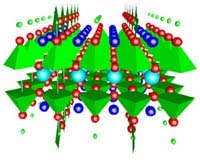
Tallahassee - Aug 28, 2003 Engineers and scientists at the National High Magnetic Field Laboratory (NHMFL) successfully tested an innovative 5 tesla high temperature superconductor (HTS) insert coil in a 20 tesla powered magnet at the laboratory on August 23, 2003. This test represents the first time that a superconducting magnet has ever generated magnetic fields of 25 tesla. The HTS insert coil broke at least seven world records, including the highest field generated in a superconducting magnet and highest increment of field in an HTS insert of useful size. These records were previously held by Japanese industrial scientists. "This is a critical and essential technological breakthrough for high temperature superconducting materials for state-of-the-art magnets," stated project leader, Dr. Justin Schwartz. Dr. Schwartz and his team, in collaboration with Oxford Superconducting Technology of Carteret, New Jersey, have been working together for about a decade to demonstrate that HTS materials can be used to reach higher magnetic fields for research in chemistry, physics, biology, and medicine. This successful test is the culmination a concentrated three-year effort within this university/industry partnership. Dr. Ken Marken, the Project Leader at Oxford noted, "The drive for ever higher fields in commercial NMR spectroscopy magnets was a compelling motivation for Oxford�s investment in this achievement, and we look forward to using the technological advances demonstrated in our high field business." "Every advance in high field superconducting magnet technology drives new and exciting scientific opportunities. For example, one of the most rapidly growing applications of superconducting magnet technology is the use of the MRI for improved diagnostic medicine," commented Dr. Schwartz. "In biology and chemistry, these high field magnets play an important role in charting the human genome, understanding protein structure, and determining nucleic acid structure. The mysteries of complex biomolecules are being unlocked at higher fields, as well as studying real time changes in biological tissues," he added. "This successful demonstration is an important step in meeting the need for high fields in superconducting magnets that has remained elusive for nearly two decades," commented Dr. Jack Crow, director of the NHMFL. Superconducting magnet technology for almost twenty years has been limited to 20 tesla. The discovery of new HTS materials in the mid-1980�s opened up great potential for applying these materials in new technologies, however, researchers have found it an extremely challenging task. One of the original charges to the NHMFL by the National Science Foundation is to produce superconducting magnets at 25 tesla and beyond. Oxford Superconducting Technology supplied long-lengths of Bi-2212 superconducting wire for the successful experimental program. The NHMFL and Oxford research teams spent much time on conductor development and characterization, coil winding studies, and the testing of coils in order to reach this world-record achievement. Community Email This Article Comment On This Article Related Links National High Magnetic Field Laboratory Florida State University SpaceDaily Search SpaceDaily Subscribe To SpaceDaily Express Space Technology News - Applications and Research
 Industry Team Achieve New Communications Technology With AESA Radars
 Baltimore MD (SPX) Jan 12, 2006
A team comprised of three leading US aerospace and defense contractors has demonstrated an innovative technological use of active electronically scanned array (AESA) radars for high-bandwidth communications. |
|
|

| The content herein, unless otherwise known to be public domain, are Copyright 1995-2006 - SpaceDaily.AFP and UPI Wire Stories are copyright Agence France-Presse and United Press International. ESA PortalReports are copyright European Space Agency. All NASA sourced material is public domain. Additionalcopyrights may apply in whole or part to other bona fide parties. Advertising does not imply endorsement,agreement or approval of any opinions, statements or information provided by SpaceDaily on any Web page published or hosted by SpaceDaily. Privacy Statement |