|
 |
 |
 |
 |
 |
 |
 |
 |

 |
Researchers See Upwellings That Could Be Root Of Volcanic Islands
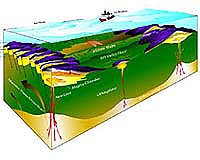
Tempe AZ (SPX) Jun 02, 2005 Deep within Earth, researchers are finding hints of exotic materials and behaviors unrivaled anywhere else on the planet. Now a team of researchers is making connections between the dynamic activities deep inside Earth and geologic features at its surface. The researchers, which include two seismologists from Arizona State University, have detected a relatively small and isolated patch of exotic material, called an ultra low velocity zone (ULVZ), that may in fact be a "root" for mantle plumes that connect Earth's hot and tumultuous core and its surface. Specifically, the researchers have found a spot at Earth's core-mantle boundary, 3,000 km (1,900 miles) deep inside Earth that could play a pivotal role in the formation and existence of volcanic islands and island chains like Hawaii. "This is a small and very isolated region of possibly molten mantle material that is sitting at Earth's core mantle boundary," said Sebastian Rost, an ASU faculty research associate. Rost and fellow researchers -- seismologist Edward Garnero of ASU, Quentin Williams of the University of California-Santa Cruz, and Michael Manga of University of California Berkeley -- recently detected an ultra low velocity zone, a region where seismic waves propagate extremely slowly, under the southwest Pacific Ocean. They report their findings in the June 2 issue of Nature. In "Seismological Constraints on a Possible Plume Root at the Core Mantle Boundary," the researchers describe a small and highly active region of inner Earth that is peculiar on several levels. "We have identified a little bubble of partially molten rock at the bottom of Earth's solid mantle, which we relate to a plume of hot material," said Garnero. "Such plumes may give rise to surface volcanoes, like Hawaii or Iceland. Now we might know what feeds such plumes." The size of the "bubble" is about 50 km (30 miles) across, smaller than the metropolitan Phoenix area, and only about 8 km (5 miles) deep. The density of the material in the bubble is significantly higher than the density of the area that surrounds it. "It might be that every plume might have one of these at its source," Rost explained. "Geodynamic modeling shows that these dense blobs of material don't move around a lot in the mantle. So while the mantle is convecting, and material is moving around, these dense piles of material do not get pushed around that much. They may actually give a stable root to long lived mantle plumes and that might be the reason why we have island chains like Hawaii." The team studied a portion of Earth's core-mantle boundary layer (CMB) - where Earth's molten iron core meets the silicate mantle rock, east of Australia and slightly to the south of New Caledonia. Traditional thought of this area inside Earth had been of a fairly well defined and predictable region. Researchers now are finding that the core mantle boundary is a complex and dynamic area that churns and chugs as the liquid iron core roils at the bottom of the rock-like mantle, Garnero said. Within this environment lies the peculiar bubble of ULVZ material. "It is very isolated, very dense and it is partially molten," said Garnero. "There in lies the enigma." The existence of dense and partially molten material poses a dynamical problem for keeping the material in a neat pile. It would be expected that the material spread out along the CMB, something that is not observed in the seismic data, Rost said. The researchers propose a model that resembles a sponge, where the molten material fills the holes of the sponge and is kept in place by surrounding crystals of the Earth's mantle. The material's high density might also indicate the existence of core material in this region, although leaking of the molten iron of the core in the mantle is not expected from current geophysical Earth models. The recent finding might change this view by allowing material to flow through the core-mantle boundary. The new findings were made possible by clever use of a seismic array, an instrument consisting of several distributed seismic monitoring stations in Australia. The array allowed high enough resolution to detect the relatively small bubble using seismic waves that are reflected from the CMB. The monitoring stations were first installed in the 1960s to detect nuclear detonations and can be used like a sensitive antenna to look deep inside Earth. In this study, the team sampled a 100 x 250 km region using newly assembled data sets of 305 Tonga-Fiji earthquakes recorded at the small-scale (20 km diameter) Warramunga seismic array. The team basically used the array data as a way to perform ultrasound scans of Earth's interior. Rost said one of the tasks of the team in follow up studies is to determine "if this is just a tiny bubble or a paradigm for what is down there." The work, according to Garnero, is helping seismologists see the inner workings of Earth in a new light and will help fill out their view of the relationship between Earth's interior and its surface. "Other researchers have suggested that by using seismic tomography they can see where mantle plumes appear to be connected from Earth's surface down to the core mantle boundary," Garnero said. "This work enables us to go to those areas, and study them in great detail, to see if the hot spots at the surface are connected at the core mantle boundary. It gives us a chance to connect the dots between the surface and the core." Community Email This Article Comment On This Article Related Links Arizona State University SpaceDaily Search SpaceDaily Subscribe To SpaceDaily Express Tectonic Science and News
 UN Criticises India Refusal To Share Data On Low Magnitude Quakes
 Hyderabad, India (AFP) Dec 16, 2005
India said Friday it would not share information on earthquakes below a magnitude of six on the Richter scale due to security concerns, drawing criticism from the United Nations. |
|
|

| The content herein, unless otherwise known to be public domain, are Copyright 1995-2006 - SpaceDaily.AFP and UPI Wire Stories are copyright Agence France-Presse and United Press International. ESA PortalReports are copyright European Space Agency. All NASA sourced material is public domain. Additionalcopyrights may apply in whole or part to other bona fide parties. Advertising does not imply endorsement,agreement or approval of any opinions, statements or information provided by SpaceDaily on any Web page published or hosted by SpaceDaily. Privacy Statement |