
 |
 |
 |
 |
 |
 |
 |
 |
 |

 |
Researchers Scientists Perform High Altitude Experiments
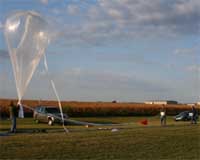
Brookings, SD (SPX) Oct 01, 2008 South Dakota State University science climbed to new heights Sept. 18 when an unmanned, high-altitude balloon carried SDSU science experiments to an altitude of more than 76,000 feet. Sioux Falls-based Aerostar International Inc. supplied the balloon and provided support for the launch from Turkey Ridge, S.D., and its retrieval about three hours later near Rowena, S.D. The balloon reached a maximum altitude of 76,777 feet above sea level and traveled a straight-line distance of roughly 36 miles from the launch position, Aerostar Flight Operations Manager Martin Harms said. Aerostar is best known as a manufacturer of manned hot air balloons and also produces all of the high altitude balloons used by NASA, as well as tethered aerostats and blimps. Aerostar offers launch services from its Sioux Falls, S.D., or Sulphur Springs, Texas, locations. SDSU assistant professor of physics Robert McTaggart said at least three SDSU experiments were designed for the high-altitude flight. Microbial stress tolerance: McTaggart and Bio/Micro-Plant Science professor Bruce Bleakley, a microbiologist, sent aloft some microorganisms to see how they respond to extreme conditions found in the earth's upper atmosphere. SDSU students working with the project will help scientists make a population count of the organisms and compare that number to a control group that hasn't been exposed to high-altitude conditions. The group will also study pictures of the organisms through a scanning electron microscope to see whether the changes in temperature and pressure have done damage to the organisms. The experiment does not monitor changes in DNA, however, but only looks for physical changes observable by microscope - damage to cell walls, for example. "We're testing organisms such as Fusarium, which is a fungus. Some species of Fusarium can survive under very extreme conditions here on the surface, making them extremophiles that can live in extreme or austere environments on earth that are not suited to most other forms of life. "Basically research like this can help examine how life developed in the early history of the earth when there wasn't an atmosphere to offer protection from ultraviolet and other types of radiation. Conditions overall were not as favorable as at present," McTaggart said. "If these organisms can survive that environment and perhaps adapt to it, then there is hope that we can find organisms on other planets that survive even harsher conditions, perhaps within our own solar system." Circuits: McTaggart sent up some electronic circuit boards to see how different conditions affect the performance of electronics. Since factors such as exposure to radiation and the loss of atmospheric pressure affect electronic components, a better understanding of those effects can help scientists prepare for communications during space travel, for example. Data for interpreting satellite imagery: Assistant professor of physics David Aaron of SDSU's Satellite Image Calibration Group used the high-altitude balloon flight to gather temperature and pressure data to evaluate changes in models. Temperature and pressure are factors that affect the transmission of different frequencies of light, so having accurate models enables scientists to adjust satellite images for greater accuracy. In addition, the flight tested a high-resolution camera provided by the Center for Earth Resources Observation and Science (EROS) outside Sioux Falls to test how well it operates at high altitude, and three different ethanol feedstocks were exposed to the environment of the upper atmosphere. Learn about Aerostar International Inc., SDSU's partner in the high-altitude research, at its Web site, http://www.aerostar.com. Founded in 1881, South Dakota State University is the state's land-grant institution as well as its largest, most comprehensive school of higher education. SDSU graduates students from eight different colleges representing more than 200 majors, minors and options. The institution also offers 20 master's degree programs and 11 Ph.D programs. Community Email This Article Comment On This Article Share This Article With Planet Earth
Related Links South Dakota State University Aerospace News at SpaceMart.com
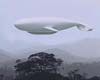
 Whale-shaped floating hotel set for flight
 Paris (UPI) Feb 2, 2008
 A 700-foot floating hotel, which resembles the Thunderbird 2 from the 1960s television series, "Thunderbirds", has been set for development, a report said. |
|
|

| The content herein, unless otherwise known to be public domain, are Copyright 1995-2007 - SpaceDaily.AFP and UPI Wire Stories are copyright Agence France-Presse and United Press International. ESA Portal Reports are copyright European Space Agency. All NASA sourced material is public domain. Additional copyrights may apply in whole or part to other bona fide parties. Advertising does not imply endorsement,agreement or approval of any opinions, statements or information provided by SpaceDaily on any Web page published or hosted by SpaceDaily. Privacy Statement |
 del.icio.us
 Digg
Digg Reddit
 YahooMyWeb
 Google
 Facebook