|
 |
 |
 |
 |
 |
 |
 |
 |

 |
Researchers Reconstruct Spread Of Bird Flu From China
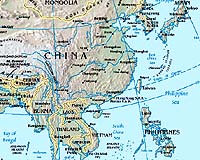
Washington (AFP) Mar 06, 2007 US researchers have reconstructed the evolution of avian flu and its spread over the past decade from its first origins in southern China, according to a new study. The team from Irvine University in California combined genetic and geographic data for the H5N1 virus, identifying many of the migration routes through which the strains spread across Asia and then around the globe. Knowing how strains of the bird flu virus can develop and migrate will help in fighting the spread of the disease, said the study published Monday in the March 6 edition of the Proceedings of the National Academy of Science. "If you can control the virus at its source, you can control it more efficiently," said Walter Fitch, professor of ecology and evolutionary biology at the School of Biological Sciences and the co-author of the study. The team found that multiple strains of the virus originated in southern Guangdong province and then travelled outside the region. "With a road map of where the strain has migrated, you're more likely to isolate the strain that you should be using to make the vaccine," Fitch added. The research was the first statistical analysis of the geographic spread of the disease which has killed more than 160 people worldwide, according to the World Health Organization (WHO). From 192 samples gathered from Europe and Asia, researchers found that Guangdong, the home of a large poultry industry, was the source of many of the H5N1 strains that subsequently spread around China and to other countries. Strains which developed in Southeast Asia were mainly confined to local areas. "The ability to develop the right mutation allows the virus to hop from one host type to the next," said Robert Wallace, who was lead author on the study. "By spreading across a large area, the virus in essence can run multiple experiments in multiple locations, increasing the likelihood that it will mutate into a form that can be transmitted from human to human." World health officials are concerned that the virus could mutate so it could be passed from human to human, and have warned that should that happen there could be a global pandemic. An influenza pandemic in 1918, just after the end of World War I, killed some 20 million people worldwide. According to WHO figures, 275 people have fallen ill with the H5N1 virus since it was first identified in Southeast Asia in 2003 and a total of 167 people have died. Community Email This Article Comment On This Article Related Links The science and news of Epidemics on Earth Epidemics on Earth - Bird Flu, HIV/AIDS, Ebola
 Genome Sequence Shows What Makes Bacteria Dangerous For Troops In Iraq
 New Haven CT (SPX) Mar 12, 2007
Researchers at Yale have identified multiple pathogenic "alien islands" in the genome of the A. baumannii, bacteria that has been responsible for new and highly drug-resistant infections in combat troops in the Middle East, according to a report in the March 1 issue of Genes and Development. |
|
|

| The content herein, unless otherwise known to be public domain, are Copyright 1995-2006 - SpaceDaily.AFP and UPI Wire Stories are copyright Agence France-Presse and United Press International. ESA PortalReports are copyright European Space Agency. All NASA sourced material is public domain. Additionalcopyrights may apply in whole or part to other bona fide parties. Advertising does not imply endorsement,agreement or approval of any opinions, statements or information provided by SpaceDaily on any Web page published or hosted by SpaceDaily. Privacy Statement |