|
 |
 |
 |
 |
 |
 |
 |
 |

 |
Researchers Propose New Molecule To Explain Circadian Clock
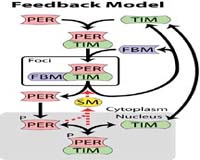
Cornell NJ (SPX) Sep 04, 2007 The internal clock in living beings that regulates sleeping and waking patterns -- usually called the circadian clock -- has often befuddled scientists due to its mysterious time delays. Molecular interactions that regulate the circadian clock happen within milliseconds, yet the body clock resets about every 24 hours. What, then, stretches the expression of the clock over such a relatively long period? Cornell researchers have contributed to the answer, thanks to new mathematical models recently published. In the August online edition of Public Library of Science (PLOS) Computational Biology, Cornell biomolecular engineer Kelvin Lee, in collaboration with graduate student Robert S. Kuczenski, Kevin C. Hong '05 and Jordi Garcia-Ojalvo of Universitat Politecnica de Catalunya, Spain, hypothesize that the accepted model of circadian rhythmicity may be missing a key link, based on a mathematical model of what happens during the sleeping/waking cycle in fruit flies. "We didn't discover any new proteins or genes," Lee said. "We took all the existing knowledge, and we tried to organize it." Using mathematical models initially created by Hong, who has since graduated, the team set out to map the molecular interactions of proteins called period and timeless -- widely known to be related to the circadian clock. The group hypothesized that an extra, unknown protein would need to be inserted into the cycle with period and timeless, a molecule that Kuczenski named the focus-binding mediator, in order for the cycle to stretch to 24 hours. Lee said many scientists are interested in studying the circadian clock, and not just to understand such concepts as jet lag -- fatigue induced by traveling across time zones. Understanding the body's biological cycle might, for example, lead to better timing of delivering chemotherapy, when the body would be most receptive, Lee said. Community Email This Article Comment On This Article Related Links All About Human Beings and How We Got To Be Here
 How Much Will You Pay To Live Near People Like You
 Durham NC (SPX) Sep 05, 2007
Using restricted-access Census data, a new study examines a quarter-million households on a block-by-block basis to yield new results about the correlation between household attributes and school quality. The researchers find that, conditional on income, households prefer to self-segregate on the basis of both race and education. |
|
|

| The content herein, unless otherwise known to be public domain, are Copyright 1995-2007 - SpaceDaily.AFP and UPI Wire Stories are copyright Agence France-Presse and United Press International. ESA Portal Reports are copyright European Space Agency. All NASA sourced material is public domain. Additional copyrights may apply in whole or part to other bona fide parties. Advertising does not imply endorsement,agreement or approval of any opinions, statements or information provided by SpaceDaily on any Web page published or hosted by SpaceDaily. Privacy Statement |