|
 |
 |
 |
 |
 |
 |
 |
 |

 |
Researchers Find Evidence Of Photosynthesis Deep Within The Ocean
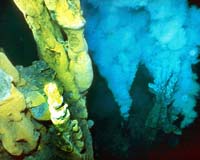
Tempe AZ (SPX) Jun 21, 2005 A team of researchers, including a photosynthesis expert from Arizona State University, has found evidence of photosynthesis taking place deep within the Pacific Ocean. The team found a bacterium that is the first photosynthetic organism that doesn't live off sunlight but from the dim light coming from hydrothermal vents nearly 2,400 meters (7,875 feet) deep in the ocean. The discovery of the green sulfur bacteria living near hydrothermal vents off the coast of Mexico has significant implications for the resiliency of life on Earth and possibly on other planets, said Robert Blankenship, a member of the research team and professor and chair of ASU's chemistry and biochemistry department. "Life finds a way," Blankenship said of the plucky bacteria that were found in a vent field called 9 North off the coast of Mexico. The bacteria apparently live in the razor thin interface between the extremely hot water (350 C) coming from a flange vent and the very cold water (2 C) surrounding it. The research team is led by J. Thomas Beatty of the University of British Columbia, Vancouver, B.C., Canada. They published their discovery in "An obligately photosynthetic bacterial anaerobe from a deep sea hydrothermal vent," in the June 20 issue of the Proceedings of the National Academy of Sciences. In addition to Blankenship and Beatty, team members are J�rg Overmann and Ann Manske, University of Munich, Germany; Michael Lince, Arizona State University; Andrew Lang, University of British Columbia and University of Alaska, Fairbanks; Cindy Van Dover, College of William & Mary, Williamsburg, Va.; Tracey Martinson, University of Alaska, Fairbanks; and F. Gerald Plumley, University of Alaska, Fairbanks and the Bermuda Biological Station for Research, St. George's, Bermuda. The team collected water samples around the hydrothermal vents of 9 North and surrounding areas. From the samples near the vents, they cultivated a microbe that grew in response to illumination near the thermal vents. Using DNA analysis the team classified the microbe as a member of the green sulfur bacteria family, which use light and sulfur to obtain energy. The fact that the organism is obligate means it solely relies on photosynthesis to live. "This is startling in the sense that you do not expect to find photosynthesis in a region of the world that is so completely dark," Blankenship said. Sunlight can penetrate 100 to 200 meters into the ocean, slowly dimming as you go deeper. Because these organisms live nearly 2,400 meter below the surface, the team believes they must be getting light from the hydrothermal vent near where they were found. "These organisms are the champions of low light photosynthesis," Blankenship said. "These guys have the most elaborate and sophisticated antenna system, which we have studied for a long time in organisms that are relatives of the one discovered near the vents." Blankenship explained that the antenna system of the bacteria utilizes a chlorosome complex, which basically acts like a microscopic satellite dish, to efficiently collect any light it can and transfer it to the organism's reaction center. The reaction center is where the actual photosynthesis takes place. Blankenship says this discovery is important on two different levels. One is what it means to life on Earth, the other is what it means about where to look for life forms on other planets. "This shows that photosynthesis is something that is not limited only to the very surface of our planet," he said. "It lets you consider other places where you might find photosynthesis on Earth as well as on other planets." For example, Europa, a planet-sized satellite of Jupiter, has long been thought to have some of the necessary attributes to harbor life. However, it is far too distant from the Sun for traditional forms of photosynthesis. It is believed that under the ice covered surface of Europa are liquid oceans and at the bottom of those oceans it is speculated there might be very hot thermal vents and potential for spawning photosynthetic organisms. "This find shows us that there is this ability of organisms to survive and live in areas that we wouldn't have imagined possible, and that life is much stronger than what we realized," Blankenship said. "This is just one example of life in extreme environments." Community Email This Article Comment On This Article Related Links Arizona State University SpaceDaily Search SpaceDaily Subscribe To SpaceDaily Express Dirt, rocks and all the stuff we stand on firmly
 Magnetic Reconnection Region Larger Than 2.5 Million Km Found In The Solar Wind
 Paris (ESA) Jan 12, 2006
Using the ESA Cluster spacecraft and the NASA Wind and ACE satellites, a team of American and European scientists have discovered the largest jets of particles created between the Earth and the Sun by magnetic reconnection. This result makes the cover of this week's issue of Nature. |
|
|

| The content herein, unless otherwise known to be public domain, are Copyright 1995-2006 - SpaceDaily.AFP and UPI Wire Stories are copyright Agence France-Presse and United Press International. ESA PortalReports are copyright European Space Agency. All NASA sourced material is public domain. Additionalcopyrights may apply in whole or part to other bona fide parties. Advertising does not imply endorsement,agreement or approval of any opinions, statements or information provided by SpaceDaily on any Web page published or hosted by SpaceDaily. Privacy Statement |