|
 |
 |
 |
 |
 |
 |
 |
 |

 |
Researchers Find A Potential Key To Human Immune Suppression In Space
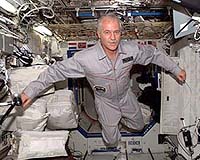
San Francisco CA (SPX) Oct 13, 2005 Researchers at the San Francisco VA Medical Center have identified a set of key immune-response genes that do not turn on in a weightless environment. The discovery is another clue in the effort to solve an almost 40-year-old mystery: why the human immune system does not function well in the weightlessness of space. The researchers, led by SFVAMC biochemist and former astronaut Millie Hughes-Fulford, PhD, identified a signaling pathway called PKA that in a gravity field responds to the presence of a pathogen by stimulating the expression of 99 genes that in turn cause the activation of T-cells, which are essential for proper immune function. Hughes-Fulford found that in the simulated absence of gravity, the PKA pathway did not respond to the pathogen's presence; as a result, 91 genes were not induced and eight genes were significantly inhibited, severely reducing the activation of T-cells. The paper was published on October 6 in FJ Express, the online rapid-publication section of the Journal of the Federation of American Societies for Experimental Biology. "This is a specific signal pathway that is not working in the absence of gravity," says Hughes-Fulford, who is also an adjunct professor of medicine at the University of California, San Francisco. "You're short-circuiting a whole lot of the immune response -- namely, the ability to proliferate T-cells -- which shouldn't be a surprise, because life evolved in Earth's gravity field." Hughes-Fulford points out that there are only two known situations in which T-cell function is so severely compromised: HIV infection and weightlessness. The research was conducted on human immune cells in culture that were placed in a device called a random positioning machine, which simulates freefall. The researchers found that three other pathways which regulate immune function -- P13K, PKC, and pLAT -- were not affected by the absence of gravity. "Why do some pathways work and some not? Perhaps it's differences in the cytoskeleton � the interior architecture of the cell," speculates Hughes-Fulford. "It's the infrastructure of the cell, a membrane made of lipid, and maybe without gravity it's not as well-organized as it should be." Human immune suppression in space was first observed in the 1960s and 70s during the Apollo missions conducted by the United States. As the researchers note in their paper, "15 of 29 Apollo astronauts reported a bacterial or viral infection during [a mission], immediately after, or within 1 week of landing back on Earth." In 1991, Hughes-Fulford flew on STS-40, the first United States space shuttle mission dedicated to medical research. During that mission, she participated in experiments that identified T-cells as the particular components of immune function that were compromised. Her current study is the first to identify a specific mechanism for T-cell suppression in a weightless environment. "It's a potential key to understanding the lack of immune response in microgravity, thereby giving us a unique target for treatment," Hughes-Fulford says. She notes that the problem of immune function must be solved if human beings are ever to live and work in space for extended periods of time. Hughes-Fulford will continue her research in September, 2006, when Russian cosmonauts carry a custom-designed container housing the same experiment aboard a Soyuz spacecraft that is scheduled to deliver supplies and experiments to the International Space Station and then return to Earth. "We know how these genes behave in simulated microgravity," she says. "The results from Soyuz should tell us what happens during spaceflight, in real microgravity." Other authors of the study include J.B. Boonyaratanakornkit, BS, of UCSF; Augusto Cogoli, PhD, of the Swiss Federal Institute of Technology; Chai-Fei Li, BS, of the Northern California Institute for Research and Education; Thomas Schopper, BS, of the Swiss Federal Institute of Technology; and Proto Pippia, PhD, and Graci Galleri, PhD, of the University of Sassari, Italy. The research was supported by NASA grants that were administered by NCIRE, and in part by the U.S. Department of Veterans Affairs. Community Email This Article Comment On This Article Related Links SpaceDaily Search SpaceDaily Subscribe To SpaceDaily Express Space Medicine Technology and Systems
 Researchers Make Long DNA Wires For Future Medical And Electronic Devices
 Columbus OH (SPX) Dec 18, 2005
Ohio State University researchers have invented a process for uncoiling long strands of DNA and forming them into precise patterns. Ultimately, these DNA strands could act as wires in biologically based electronics and medical devices, said L. James Lee, professor of chemical and biomolecular engineering at Ohio State University. |
|
|

| The content herein, unless otherwise known to be public domain, are Copyright 1995-2006 - SpaceDaily.AFP and UPI Wire Stories are copyright Agence France-Presse and United Press International. ESA PortalReports are copyright European Space Agency. All NASA sourced material is public domain. Additionalcopyrights may apply in whole or part to other bona fide parties. Advertising does not imply endorsement,agreement or approval of any opinions, statements or information provided by SpaceDaily on any Web page published or hosted by SpaceDaily. Privacy Statement |