|
 |
 |
 |
 |
 |
 |
 |
 |

 |
Researchers Discover Really Old Trees In Amazon
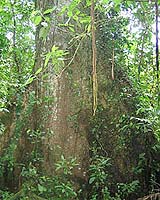
Irvine CA (SPX) Dec 08, 2005 Trees in the Amazon tropical forests are old. Really old, in fact, which comes as a surprise to a team of American and Brazilian researchers studying tree growth in the world's largest tropical region. Using radiocarbon dating methods, the team, which includes UC Irvine's Susan Trumbore, found that up to half of all trees greater than 10 centimeters in diameter are more than 300 years old. Some of the trees, Trumbore said, are as much as 750 to 1,000 years old. Study results appear in the online early edition of the Proceedings of the National Academy of Sciences. "Little was known about the age of tropical trees, because they do not have easily identified annual growth rings," added Trumbore, a professor of Earth system science. "No one had thought these tropical trees could be so old, or that they grow so slowly." And for Trumbore, who studies how forests and the atmosphere exchange carbon, these discoveries can have implications for the role the Amazon plays in determining global carbon dioxide levels. Carbon dioxide is a greenhouse gas implicated in accelerated global warming and the focus of international efforts to curb its atmospheric levels. Because their trees are old and slow-growing, the Amazon forests, which contain about a third of all carbon found in land vegetation, have less capacity to absorb atmospheric carbon than previous studies have predicted. Although some of the largest trees also grow the fastest and can take up carbon quickly, the vast majority of the Amazon trees grow slowly. "In the Central Amazon, where we found the slowest growing trees, the rates of carbon uptake are roughly half what is predicted by current global carbon cycle models," Trumbore said. "As a result, those models � which are used by scientists to understand how carbon flows through the Earth system � may be overestimating the forests' capacity to remove carbon dioxide from the atmosphere." As part of the Large-Scale Biosphere-Atmosphere Experiment in Amazonia (LBA), the researchers revealed an interesting portrait of tree life beneath the limbs of the large trees that dominate tropical forests. They found that most Amazon basin trees are so old because they grow very slowly on nutrient-poor soils in dark shade under the canopy of large trees. The growth rates they measured for Central Amazon trees are among the slowest in any forest on Earth. These results, Trumbore points out, are contrary to the widely held view that tropical forests are highly dynamic. "In addition, the impact of logging activity in the Amazon region may be longer-lasting than we think," Trumbore added, "because it may take centuries for these forests to grow back to their full size." Some of the older trees found in the study included economically valuable species. For example, three Brazil nut trees measured in the study ranged in age from 680 to 1,000 years. Supported by NASA, the LBA is a Brazilian-led international scientific program with the goal of studying how the Amazon forest affects global climate and carbon dioxide. The work was a cooperative effort among researchers at the University of Sao Paulo, University of Acre and the Institute for Amazonian Research in Brazil, and UCI and Tulane University in the U.S. Radiocarbon measurements were made at the W.M. Keck Carbon Cycle Accelerator Mass Spectrometry Facility at UCI. Community Email This Article Comment On This Article Related Links Large-Scale Biosphere-Atmosphere Experiment University of California, Irvine SpaceDaily Search SpaceDaily Subscribe To SpaceDaily Express Darwin Today At TerraDaily.com
 India Plans Ambitious Tiger Census
 New Delhi (AFP) Jan 10, 2006
India is set to launch the most ambitious headcount yet of its dwindling tiger population, focusing especially on parks where scores of the big cats have been killed for their pelt or claws. |
|
|

| The content herein, unless otherwise known to be public domain, are Copyright 1995-2006 - SpaceDaily.AFP and UPI Wire Stories are copyright Agence France-Presse and United Press International. ESA PortalReports are copyright European Space Agency. All NASA sourced material is public domain. Additionalcopyrights may apply in whole or part to other bona fide parties. Advertising does not imply endorsement,agreement or approval of any opinions, statements or information provided by SpaceDaily on any Web page published or hosted by SpaceDaily. Privacy Statement |