|
 |
 |
 |
 |
 |
 |
 |
 |

 |
Researchers Create New Class Of Compounds
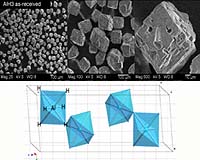
Baltimore MD (SPX) Jan 22, 2007 Researchers have synthesized a new class of aluminum-hydrogen compounds with a unique chemistry that could lead to the development of more powerful solid rocket fuel and may also, in time, be useful for hydrogen-powered vehicles or other energy applications. An article about this research, led by scientists at the Johns Hopkins and Virginia Commonwealth universities, is published in the Jan. 19 issue of the journal Science. The team also included scientists at University of Konstanz and University of Karlsruhe, both in Germany. Through combined theoretical and experimental study, the team created this new class of aluminum/hydrogen molecules (called "hydrides") that are relatively stable and are similar in structure to boranes, which are composed of boron and hydrogen atoms. This relative stability may hold the key to the compound's possible future uses in rocket fuel, said team co-leader Kit Bowen, the E. Emmet Reid Professor in the departments of Chemistry and Materials Science at Johns Hopkins. "It's always tough to predict how things will play out in the future, but our research finding is interesting enough for me to be willing to say that this synthesis may have the potential for some possibly very useful future applications, including the development of solid rocket fuel with more thrust," Bowen said. Most solid rocket fuels already rely on aluminum as a co-fuel, but the compounds synthesized by the research team "might turn out to be more efficient," Bowen said. "But that remains to be seen," he said. "These complexes are a new class of thing that, because of their various properties, can at this point only be imagined to have uses in propulsion or even in the forecasted hydrogen economy." Today's so-called "petroleum economy" relies heavily on fossil fuels for energy. In a "hydrogen economy," however, electricity to power vehicles and for the power grid could be produced with much cleaner technologies using hydrogen, the most abundant element in the universe, as a fuel. Storing this fuel, however, presents tremendous challenges, including finding a solid that efficiently "soaks up and holds" hydrogen and then releases it on demand. "There are many bridges to cross," Bowen said. "Perhaps it's best to think of the science we are doing with these new compounds as being like inventing new words. From those come sentences, paragraphs, chapters, whole books and even, eventually, Shakespeare. Small things can be the building blocks of larger ones down the line." Team co-leader Puru Jena, distinguished professor of physics at Virginia Commonwealth University, said that developing new materials and compounds that meet some of the current technological problems in energy-related fields is one of the objectives of this kind of collaborative research. "Our work has demonstrated that a synergy between experiment and theory can go a long way in meeting these challenges, particularly in developing novel nano-materials for storing and releasing hydrogen as well as for high-energetic materials applications," Jena said. Community Email This Article Comment On This Article Related Links Johns Hopkins University Rocket Science News at Space-Travel.Com
 India Delays Cryogenic Rocket Engine Test Two Weeks
 Bangalore, Indias (PTI) Jan 22, 2007
The Indian space agency did not carry out a much-awaited full duration test of the indigenous cryogenic rocket engine. The test by the Indian Space Research Organisation was put off after an anomaly was noticed during the preparation stage, its Chairman G Madhavan Nair told PTI. |
|
|

| The content herein, unless otherwise known to be public domain, are Copyright 1995-2006 - SpaceDaily.AFP and UPI Wire Stories are copyright Agence France-Presse and United Press International. ESA PortalReports are copyright European Space Agency. All NASA sourced material is public domain. Additionalcopyrights may apply in whole or part to other bona fide parties. Advertising does not imply endorsement,agreement or approval of any opinions, statements or information provided by SpaceDaily on any Web page published or hosted by SpaceDaily. Privacy Statement |