|
 |
 |
 |
 |
 |
 |
 |
 |

 |
Researchers Confirm Discovery Of Earth's Inner, Innermost Core
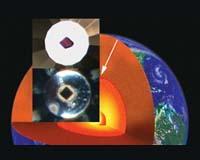
Champaign IL (SPX) Mar 12, 2008 Geologists at the University of Illinois have confirmed the discovery of Earth's inner, innermost core, and have created a three-dimensional model that describes the seismic anisotropy and texturing of iron crystals within the inner core. "For many years, we have been like blind men touching different parts of an elephant," said U. of I. geologist Xiaodong Song. "Now, for the fist time, we have a sense of the entire elephant, and see what the inner core of Earth really looks like." Using both newly acquired data and legacy data collected around the world, Song and postdoctoral research associate Xinlei Sun painstakingly probed the shape of Earth's core. The researchers report their findings in a paper accepted for publication in the journal Earth and Planetary Science Letters, and posted on its Web site. Composed mainly of iron, Earth's core consists of a solid inner core about 2,400 kilometers in diameter and a fluid outer core about 7,000 kilometers in diameter. The inner core plays an important role in the geodynamo that generates Earth's magnetic field. The solid inner core is elastically anisotropic; that is, seismic waves have different speeds along different directions. The anisotropy has been found to change with hemisphere and with radius. In the latest work, Sun and Song describe another anomaly - a global structure - found within the inner core. "To constrain the shape of the inner core anisotropy, we needed a uniform distribution of seismic waves traveling in all directions through the core," Sun said. "Since the seismic waves we studied were generated by earthquakes, one challenge was acquiring enough seismic waves recorded at enough stations." In their analysis, Sun and Song used a three-dimensional tomography technique to invert the anisotropy of the inner core. They parameterized the anisotropy of the inner core in both radial and longitudinal directions. The researchers then used a three-dimensional ray tracing method to trace and retrace the seismic waves through the inner core iteratively. What they found was a distinct change in the inner core anisotropy, clearly marking the presence of an inner inner core with a diameter of about 1,180 kilometers, slightly less than half the diameter of the inner core. The layering of the core is interpreted as different texturing, or crystalline phase, of iron in the inner core, the researchers say. "Our results suggest the outer inner core is composed of iron crystals of a single phase with different degrees of preferred alignment along Earth's spin axis," Sun said. "The inner inner core may be composed of a different phase of crystalline iron or have a different pattern of alignment." Although the anisotropy of the inner core was proposed 20 years ago, "this is the first time we have been able to piece everything together to create a three-dimensional view," Song said. "This view should help us better understand the character, mineral properties and evolution of Earth's inner core." Community Email This Article Comment On This Article Related Links University of Illinois at Urbana-Champaign Dirt, rocks and all the stuff we stand on firmly
 Move Over Galileo, Its Time for Science 2.0
 College Park MD (SPX) Mar 10, 2008
In a provocative article in this week's Science Magazine, the University of Maryland's Ben Shneiderman, one of the world's leading researchers and innovators in human-computer interaction, says it's time for the laboratory research that has defined science for the last 400 years to make room for a revolutionary new method of scientific discovery. |
|
|

| The content herein, unless otherwise known to be public domain, are Copyright 1995-2007 - SpaceDaily.AFP and UPI Wire Stories are copyright Agence France-Presse and United Press International. ESA Portal Reports are copyright European Space Agency. All NASA sourced material is public domain. Additional copyrights may apply in whole or part to other bona fide parties. Advertising does not imply endorsement,agreement or approval of any opinions, statements or information provided by SpaceDaily on any Web page published or hosted by SpaceDaily. Privacy Statement |