|
 |
 |
 |
 |
 |
 |
 |
 |

 |
Researchers Apply Agrciultural Shelterbelt Design To Coastal Tsunami Protection
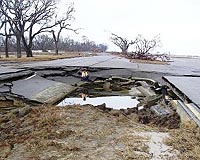
Ames IO (SPX) Apr 17, 2007 Iowa State University researchers are applying their knowledge of agricultural shelterbelts to protect coastal areas from tsunamis at the request of the United Nations' Food and Agriculture Organization (FAO). Following the devastating aftermath of Hurricane Katrina and the December 2004 tsunami in Southeast Asia, many international planning agencies have searched for ways to prevent such tragedies in the future. Gene Takle, professor of agronomy and geological and atmospheric sciences, and colleagues Mike Chen and Xiaoqing Wu in atmospheric science were asked to develop a set of guidelines for rebuilding coastal forests based on their research on wind reduction by the use of agricultural shelterbelts. The Iowa State group was commissioned to write a paper on designing coastal forests and shelterbelts, which are known as "bioshields." Takle represented the group at a workshop under sponsorship of the FAO last summer in Khao Lak, Thailand, where hundreds of bodies had washed up on the beach after the 2004 tsunami. "Much loss of life from this tsunami was attributed to destruction of coastal forests. Villages in India and Southeast Asia that preserved their coastal mangroves suffered far less damage," Takle said. "FAO requested guidelines for rebuilding these bioshields based on our work and understanding of agricultural shelterbelts." Their suggested guidelines include planting trees as close to the sea as possible; using short salt-tolerant and sparse shelters on the seaward edge; using tall species of high wind resistance on the landward side; and leaving gaps between rows and irregularly within the rows to extend the protected zone, but allowing for onshore flow of the cooling sea-breeze in nonhazardous conditions. "Very little research has been done on this topic, so we used our computer model and previous experience on flow through living barriers to evaluate alternative shelter designs like tree heights, density, spacing and orientation to develop our recommendations," Takle said. Federal managers in Southeast Asia and India will consider the guidelines when rebuilding damaged coastal areas. Takle has teamed with meteorology graduate students Dan Rajewski and Sarah Schmidt to conduct additional studies to refine the preliminary guidelines he presented at the Thailand workshop and explore additional uses of bioshields against high winds. Community Email This Article Comment On This Article Related Links Iowa State University Bring Order To A World Of Disasters When the Earth Quakes Bringing Order To A World Of Disasters When the Earth Quakes A world of storm and tempest
 Solomons Seeks Long Term Tsunami Help
 Honiara (AFP) April 16, 2007
The death toll from this month's devastating earthquake and tsunami in the Solomon Islands has risen to 52 but is unlikely to rise significantly higher, authorities said Monday. |
|
|

| The content herein, unless otherwise known to be public domain, are Copyright 1995-2006 - SpaceDaily.AFP and UPI Wire Stories are copyright Agence France-Presse and United Press International. ESA PortalReports are copyright European Space Agency. All NASA sourced material is public domain. Additionalcopyrights may apply in whole or part to other bona fide parties. Advertising does not imply endorsement,agreement or approval of any opinions, statements or information provided by SpaceDaily on any Web page published or hosted by SpaceDaily. Privacy Statement |