
 |
 |
 |
 |
 |
 |
 |
 |
 |

 |
Researchers Analyze Material With Colossal Ionic Conductivity
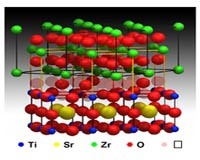
Oak Ridge TN (SPX) Aug 08, 2008 A new material characterized at the Department of Energy's Oak Ridge National Laboratory could open a pathway toward more efficient fuel cells. The material, a super-lattice developed by researchers in Spain, improves ionic conductivity near room temperature by a factor of almost 100 million, representing "a colossal increase in ionic conduction properties," said Maria Varela of ORNL's Materials Science and Technology Division, who characterized the material's structure with senior researcher Stephen Pennycook. The analysis was done with ORNL's 300 kilovolt Z-contrast scanning transmission electron microscope, which can achieve aberration-corrected resolutions near 0.6 angstrom, until recently a world record. The direct images show the crystal structure that accounts for the material's conductivity. "It is amazing," Varela said. "We can see the strained, yet still ordered, interface structure that opens up a wide pathway for ions to be conducted." Solid oxide fuel cell technology requires ion-conducting materials -- solid electrolytes -- that allow oxygen ions to travel from cathode to anode. However, existing materials have not provided atom-scale voids large enough to easily accommodate the path of a conducted ion, which is much bigger than, for example, an electron. "The new layered material solves this problem by combining two materials with very different crystal structures. The mismatch triggers a distortion of the atomic arrangement at their interface and creates a pathway through which ions can easily travel," Varela said. Other fuel cell materials force ions to travel through tight pathways with few spaces for the ions to occupy, slowing their progress. Rather than forcing the ions to jump from hole to hole, the new material has "lots of vacant spaces to be occupied," said Varela, so the ions can travel much more quickly. Unlike previous fuel cell materials, which have to achieve high temperatures to conduct ions, the new material maintains ionic conductivity near room temperatures. High temperatures have been a major roadblock for developers of fuel cell technology. The research team with Spain's Universidad Complutense de Madrid and Universidad Politecnica de Madrid produced the material and observed its outstanding conductivity properties, but the structural characteristics that enable the material to conduct ions so well were not known until the material was put under the ultra-high resolution microscopes at ORNL. The paper, a collaboration between researchers at the Universities of Madrid and at ORNL, was published in Science. Community Email This Article Comment On This Article Share This Article With Planet Earth
Related Links Oak Ridge National Laboratory Space Technology News - Applications and Research
 Argonne Scientists Discover New Class Of Glassy Material
 Argonne IL (SPX) Aug 05, 2008
Scientists at U.S. Department of Energy's Argonne National Laboratory are dealing with an entirely new type of frustration, but it's not stressing them out. |
|
|

| The content herein, unless otherwise known to be public domain, are Copyright 1995-2007 - SpaceDaily.AFP and UPI Wire Stories are copyright Agence France-Presse and United Press International. ESA Portal Reports are copyright European Space Agency. All NASA sourced material is public domain. Additional copyrights may apply in whole or part to other bona fide parties. Advertising does not imply endorsement,agreement or approval of any opinions, statements or information provided by SpaceDaily on any Web page published or hosted by SpaceDaily. Privacy Statement |
 del.icio.us
 Digg
Digg Reddit
 YahooMyWeb
 Google
 Facebook