
 |
 |
 |
 |
 |
 |
 |
 |
 |

 |

Washington (UPI) Aug 4, 2010 More research is needed to understand the long-term effects of oil dispersants, especially considering their underwater use, experts and lawmakers said at a U.S. Senate committee hearing Wednesday. Experts called to testify before the Committee on Environment and Public Works assessed the use of oil dispersants in the Deepwater Horizon oil spill in the Gulf of Mexico. Dispersants are a chemical mixture that, when applied to spilled oil, break it into small droplets that can be degraded by microscopic organisms. "More needs to be done to understand what effects dispersants are having beneath the surface," said U.S. Sen. Barbara Boxer, D-Calif. All of the academics at the hearing shared Boxer's concern. Of the approximately 1.8 million gallons of dispersants used in the gulf spill, about 42 percent were applied below the surface at the site of the leak, said Ronald Kendall, chairman of the department of environmental toxicology at Texas Tech University. We have no idea how microorganisms respond to dispersants in the deep sea, said David Smith, associate dean of the graduate school of oceanography at the University of Rhode Island. "There are far fewer microorganisms in the deep sea compared to the surface," Smith said in his statement. "This, combined with lower water temperatures, will result in a slower rate of degradation." This could lead to a greater concentration of subsurface oil and ultimately contamination of the seafloor. On the surface, others argue that the ends justify the means. Paul Anastas, assistant administrator of the U.S. Environmental Protection Agency's Office of Research and Development, it is believed that subsurface dispersant use resulted in less dispersant being used overall. "Let me be clear, nobody is advocating for the use of dispersants unless they are necessary," said Sen. James Inhofe, R-Okla. "But with the BP spill they seem to be the lesser of two evils." David Westerholm, director of the National Oceanic and Atmospheric Administration's Office of Response and Restoration, likened the choice to a doctor making a diagnosis -- you have to make a decision at a moment in time based on a certain set of tools. Similarly, he said, the decision to use dispersants wasn't done lightly and it was made with a lot of factors in mind. "Dispersants are generally less toxic than oil, they reduce risks to shorelines and degrade quickly over several days to weeks, according to modeling results," said Anastas in his statement. He added that his agency isn't seeing dispersants near coasts or wetlands.
Share This Article With Planet Earth
Related Links Our Polluted World and Cleaning It Up

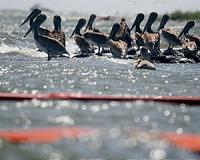 Gulf spill impact will linger long after oil is gone: study
Washington (AFP) Aug 3, 2010 Oil is no longer spewing from the ruptured BP oil well but the disaster is far from over for families who live along the US Gulf coast, and their kids in particular, a major study said Tuesday. Of 1,200 coastal residents surveyed last month by researchers at the National Center for Disaster Preparedness (NCDP) at Columbia University, a third said their kids have developed mental, behavioral ... read more |
|
|
| The content herein, unless otherwise known to be public domain, are Copyright 1995-2010 - SpaceDaily. AFP and UPI Wire Stories are copyright Agence France-Presse and United Press International. ESA Portal Reports are copyright European Space Agency. All NASA sourced material is public domain. Additional copyrights may apply in whole or part to other bona fide parties. Advertising does not imply endorsement,agreement or approval of any opinions, statements or information provided by SpaceDaily on any Web page published or hosted by SpaceDaily. Privacy Statement |


 del.icio.us
 Digg
Digg Reddit
 YahooMyWeb
 Google
 Facebook


