|
 |
 |
 |
 |
 |
 |
 |
 |

 |
Research Expedition Braves Worlds Worst Weather
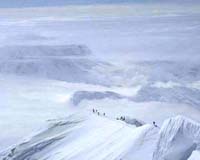
Fairbanks AL (SPX) Jun 22, 2006 The Mount McKinley Project, funded by the International Arctic Research Center (IARC) at the University of Alaska Fairbanks, has endured its share of horrific blizzards, heart-stopping ridge ascents and the unrelenting burn of a blazing sun during the past four seasons of weather station installation. The expedition climbs to 18,700 feet, just below the 20,320 foot summit of Mount McKinley, to perform upgrades to the weather station perched upon the tallest peak in North America. It's one of the three highest altitude meteorological stations in the world. In recent years the equipment contained two components, a weather station to record meteorological data and a telemetric component to broadcast data to a base station in the town of Cantwell. The weather station failed at some point during the previous four seasons, causing researchers to modify the design. Last year, although the telemetry worked well, the data contained obvious inaccuracies after September. With continued support from the National Park Service, this year the expedition returns for a fifth acquaintance with McKinley. The expedition commenced June 7, and will last until the end of the month. Two anemometers, or wind measuring devices, are included in this year's weather station design. One is a standard instrument with three rotating cups and the other is an ultrasonic device, which measures wind speed by monitoring a signal sent between two sensors. As they work side by side, these anemometers will reveal information about sensor accuracy. The project started about a decade before it was funded by IARC. Yoshitomi Okura, who is affiliated with the Japanese Alpine Club, started the project in the early 1990s after three of his friends were blown off the mountain and killed. One of the most famous Japanese climbers, Naomi Vemura, also diappeared at about the same location. Tohru Saito, a liaison with IARC, who will be ascending McKinley for the fifth consecutive year, stated, "Okura is passionate about collecting data from McKinley, both to understand the nature of the fierce winds and to prove that climbers like his friends were not inexperienced, they just faced incomprehensible conditions." Community Email This Article Comment On This Article Related Links University of Alaska Fairbanks Weather News at TerraDaily.com
 Boeing Hands Over GOES-N Early To NASA
 St Louis MO (SPX) Jun 21, 2006
Boeing announced Wednesday that GOES-N - the first of three Geostationary Operational Environmental Satellites built for NASA and the NOAA - has reached its orbital slot 22,300 miles above the equator, and Boeing engineers have transferred control of the satellite to NASA. |
|
|

| The content herein, unless otherwise known to be public domain, are Copyright 1995-2006 - SpaceDaily.AFP and UPI Wire Stories are copyright Agence France-Presse and United Press International. ESA PortalReports are copyright European Space Agency. All NASA sourced material is public domain. Additionalcopyrights may apply in whole or part to other bona fide parties. Advertising does not imply endorsement,agreement or approval of any opinions, statements or information provided by SpaceDaily on any Web page published or hosted by SpaceDaily. Privacy Statement |