|
 |
 |
 |
 |
 |
 |
 |
 |

 |
Research And Development Takes Robots And Automation Into New Territory
San Jose - May 6, 2003 Robotic automation has helped trim expenses and downtime by enabling corporations to manufacture more than one product on a production line. Cost savings can be achieved by fulfilling production needs inhouse. Not only does robotic automation provide better quality products and greater output than manual processes, but it also diminishes the levels of scrap and rework, making it a cost-efficient method even in countries where labor costs are low. Robots' increasing advantages over fixed automation and physical labor have broadened their scope of applications in industries such as medical, manufacturing, and automotive. Robots are breaking out of their cocoon of shop floor assistance and have begun servicing more sophisticated segments including photonics and fiber optics. With manufacturers integrating enhanced vision and audio capabilities, these machines have become more flexible and skillful. "Researchers and technologists are increasingly striving toward developing innovative techniques that include the use of artificial intelligence and progress to less human supervision," states Technical Insights Analyst Anand Subramanian. These modern robotics systems aid surgeons performing complicated cardiac and abdominal operations without making large incisions. Dexterous, voice-controlled robots can facilitate efficient microscale operations by eliding hand tremors and offering visual magnifications. "Surgical robots enable the surgeon to perform the surgery at the same level of quality and time but with less pain, quicker recovery, and less blood loss for the patient," explains Anand. Simple concepts and complicated technology in robotics is anticipated to improve the quality of life for the physically challenged. Through repetitive exercises, robots can retrain the brain to control certain muscles, helping the patients toward a fuller and faster recovery. Robots will find endless uses in assessing global climate systems, aiding military campaigns, and carrying out household tasks. Researchers have been designing space-age robots that simulate human movements and speech, closing the gap between man-machine communication. New analysis by Technical Insights, a business unit of Frost & Sullivan, Robotics and Automation, noting that several primary and secondary sectors are likely to gain from improvements in robotics. Artificial intelligence is expected to pave the way for a radical scenario where robots will not only help humans in mechanical processes, but also naturally interact with them using psychological sensors. Community Email This Article Comment On This Article Related Links Frost & Sullivan SpaceDaily Search SpaceDaily Subscribe To SpaceDaily Express All about the robots on Earth and beyond!
 Engineers Deliver Robot to Neutralize Remote Explosives
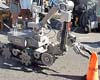 Tyndall AFB (SPX) Jun 30, 2005
Engineers from the Air Force Research Laboratory Materials and Manufacturing Directorate have rapidly prototyped, developed, and delivered low-cost expendable robots to disable and dispose of improvised explosive devices. |
|
|

| The content herein, unless otherwise known to be public domain, are Copyright 1995-2006 - SpaceDaily.AFP and UPI Wire Stories are copyright Agence France-Presse and United Press International. ESA PortalReports are copyright European Space Agency. All NASA sourced material is public domain. Additionalcopyrights may apply in whole or part to other bona fide parties. Advertising does not imply endorsement,agreement or approval of any opinions, statements or information provided by SpaceDaily on any Web page published or hosted by SpaceDaily. Privacy Statement |