|
 |
 |
 |
 |
 |
 |
 |
 |

 |
Republic of Congo Announces Two Massive Protected Areas
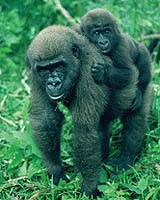
Brazzaville, Congo (SPX) Sep 20, 2006 The Minister of Forestry Economy of the Republic of Congo announced today plans to create two new protected areas that together could be larger than Yellowstone National Park, spanning nearly one million hectares (3,800 square miles). Instead of bison and elk, these new protected areas contain elephants, chimpanzees, hippos, crocodiles, and some of the highest densities of gorillas on earth. The announcement was made by Minister Henri Djombo and officials from the Bronx Zoo-based Wildlife Conservation Society (WCS) at the United Nations. "We are delighted that the Republic of Congo continues to take a leadership role in safeguarding its world-class wildlife and wildlands for generations to come," said Dr. John Robinson, WCS executive vice president for conservation and science. "This is an extraordinary achievement for the entire Congo basin region." "The Republic of Congo depends on forest resource use for economic development, but it is also deeply committed to biodiversity conservation and sustainable forest management. It has already set aside an estimated 11 percent of the country's surface area as protected areas, 90 percent of which is tropical forest. Establishing these new protected areas reinforces the protected area network portfolio and affirms this commitment," said Henri Djombo, Congo's Minister of Forestry Economy. The first new protected area to be created, will be called Ougoue-Lekiti National Park, and lies in the western part of the country. It will adjoin Bateke National Park in Gabon, which was established with WCS's help in 2002. Together this transboundary protected area will safeguard some 600,000 hectares (2,300 square miles). The northern half of Ougoue-Leketi contains a vast and ancient sand dune system, and is covered by large grass and wooded savanna patches separated by fine lines of dense gallery forest, along with a multitude of small lakes and river valleys. The south and west of the new park supports an intact block of Chaillu forest and the Ougue River basin along which a series of important natural forest clearings are used by forest elephants and other large mammals. Until recently the region contained lions - unusual to the Congo Basin - though poaching may have wiped out the population. The Savanna landscape still supports such rare species as Grimm's duiker (a small antelope species), side-striped jackal, and rare birds including Denham's bustard. Inside its forests roam elephants, forest buffalo, bush pigs, leopards, gorillas, chimpanzees and several monkey species. The second protected area to be created in the coming year - Ntokou-Pikounda - lies southeast of Odzala Kokoua National Park, which is well-known for one of the highest gorilla populations in the world. WCS conservationist Dr. Mike Fay identified parts of this area as the "Green Abyss" in 2000, during his "Mega-transect," an expedition co-sponsored by National Geographic. Fay also recorded extremely high densities of great apes in the region's broad Marantacae forests. Even though the deadly Ebola virus has decimated great ape populations in nearby regions of northern Congo and Gabon, preliminary surveys of Ntokou-Pikounda by WCS and the Government of Congo indicate that this region still contains healthy gorilla and chimpanzee numbers, and may in fact support some of the highest great ape densities on the planet. Along with great apes, this mosaic of swamp forest, clearings, and mixed forests region contains elephants, chimpanzees, crocodiles, hippos, as well as rare and threatened birds such as crowned eagles and many species of hornbills. According to WCS, large mammal populations are still relatively strong because many core areas are beyond the current reach of bushmeat hunters, leaving relatively undisturbed habitat. "These two new protected areas are a tremendous addition to the Republic of Congo's protected-area network and to global protection of biodiversity," said Dr. Paul Elkan who directs WCS's Congo program. "The Ougoue-Lekiti will protect a critical ecotone zone, a block of intact Chaillu forest, a mix of savanna and forest wildlife. The Ntokou-Pikounda forest will be a stronghold for great apes and forest elephants. "There is already a great deal of local community support for the creation of both these protected areas. We look forward to working with the Congolese Government in making these effective protected areas and foundations for landscape scale management in the Congo basin." During its recent visit to the U.S., the Congolese Government also announced several other initiatives aimed at improving conservation of its forests, including rehabilitation of neglected protected areas, supporting ecotourism of existing national parks, and investigating more cross-border conservation with neighboring countries. Community Email This Article Comment On This Article Related Links Wildlife Conservation Society Save the Forests at Wood Pile Forestry News - Global and Local News, Science and Application
 Fires Rage As Haze Thickens In Borneo
 Jakarta (AFP) Sep 08, 2006
At least eight million hectares across Indonesia have been damaged by forest fires in the last month, officials said Friday as dozens of uncontrolled blazes continued on Borneo island. A forestry ministry official admitted that forest and ground fires had destroyed millions of hectares of land in Indonesia last month, with a satellite system detecting 52,599 hotspots during August. |
|
|

| The content herein, unless otherwise known to be public domain, are Copyright 1995-2006 - SpaceDaily.AFP and UPI Wire Stories are copyright Agence France-Presse and United Press International. ESA PortalReports are copyright European Space Agency. All NASA sourced material is public domain. Additionalcopyrights may apply in whole or part to other bona fide parties. Advertising does not imply endorsement,agreement or approval of any opinions, statements or information provided by SpaceDaily on any Web page published or hosted by SpaceDaily. Privacy Statement |