|
 |
 |
 |
 |
 |
 |
 |
 |

 |
Rensselaer Engineer Joins Team To Study Levee Failures In New Orleans
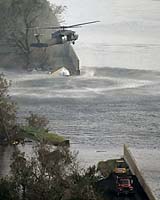
Troy NY (SPX) Oct 11, 2005 A Rensselaer Polytechnic Institute engineer is headed to New Orleans as part of an expert team investigating levee failures in the aftermath of Hurricane Katrina. The researchers, who are funded by a special exploratory grant from the National Science Foundation (NSF), plan to take lessons from the disaster and apply them to the design of levee systems across the country. Tom Zimmie, professor and acting chair of civil and environmental engineering at Rensselaer, was recruited for the project by Ray Seed, professor of civil engineering at the University of California, Berkeley. Seed has brought together a group of nationally recognized experts with extensive experience in the field of natural disasters. The team will be collaborating with the U.S. Army Corps of Engineers and the American Society of Civil Engineers. "Civil engineers have been warning of the possibility that a hurricane might breech the levees in New Orleans for years, with the potential for catastrophic flooding," Zimmie says. "There are hundreds of miles of similar levees across the United States, and we need a better understanding of how to design these systems to protect people from future disasters." In the coming weeks, the team will investigate a number of aspects of the New Orleans levees, including the damage caused by wind-driven waves and overtopping, the effectiveness of emergency "patches" put in place by responders, and the decision process behind the levee configuration, according to Zimmie. Some levees did not fail, and these provide a further opportunity to gain insight into the design of current and future levee systems. Zimmie has extensive experience with all types of engineered structures, but most recently his research has focused on how explosions affect dams, pipelines, and other entrenchments -- including levees. He and his colleagues at Rensselaer are specifically interested in understanding how to design levees to withstand a possible terrorist attack. "The most critical time for embankments and levees is during flood conditions," Zimmie says. "The Mississippi River floods every spring near New Orleans, and the city is obviously not evacuated. Just imagine if there was a terrorist attack during that time." Using a 150 g-ton centrifuge, Zimmie tests models of structures to simulate their response to different levels of explosions. The goal is to find out how much explosive it would take to breach a dam or levee in a certain location, with certain soil characteristics, to help engineers design structures to withstand such blasts. Zimmie's work at Rensselaer's Geotechnical Centrifuge Research Center is part of NSF's nationwide Network for Earthquake Engineering Simulation (NEES). Community Email This Article Comment On This Article Related Links Video of the centrifuge SpaceDaily Search SpaceDaily Subscribe To SpaceDaily Express Bringing Order To A World Of Disasters A world of storm and tempest When the Earth Quakes
 ISRO Developing Ocean Bottom Warning Sensors
 Bangalore, India (SPX) Jan 11, 2006
Indian Space Research Organisation is developing ocean bottom sensors that will help warn tsunami strikes in advance, the Press Trust Of India reports. |
|
|

| The content herein, unless otherwise known to be public domain, are Copyright 1995-2006 - SpaceDaily.AFP and UPI Wire Stories are copyright Agence France-Presse and United Press International. ESA PortalReports are copyright European Space Agency. All NASA sourced material is public domain. Additionalcopyrights may apply in whole or part to other bona fide parties. Advertising does not imply endorsement,agreement or approval of any opinions, statements or information provided by SpaceDaily on any Web page published or hosted by SpaceDaily. Privacy Statement |